

.png)

Is one of your goals this year to be more efficient at work? Embrace technology? Save on operating costs? If that sounds like you, these 9 sales tools are for you. The best bit? They’re all free. Let’s have a look!
*Pricing information as of 19th January 2023, prices may change at any moment.

What is it?
Fathom is a relatively new transcription service for Zoom which allows you to record, transcribe, and highlight vital moments during your call. Their transcription/voice recognition accuracy blows the competition away, and it’s straightforward to use.
Feeling like you in-meeting note taking is making you miss vital info? Boot up Fathom and get it to take the notes for you.
Pricing
I discovered Fathom recently and I couldn’t believe the quality I was getting with its transcriptions and that the tool was 100% free. Jump on it now while it still is!


What is it?
Loom is a video messaging/comms tool which allows you to record your screen, voice, and self to produce quick-sharing presentations and messages. It’s a great tool for quickly sharing your point across in a clear way. Thanks to Loom’s quick sharing, I use it often for content production and to communicate with team mates.
Need to walk a customer through a new product virtually? Record your desktop, camera, and mic together to give them a rich experience.
Pricing
Loom’s free Starter level limits you to 25 videos at up to 5-mins long. When you cap those limits, you’ll need to upgrade. Here’s their current pricing:


What is it?
Calendly is a popular meeting scheduling tool which automates the meeting setup process. If you despise emailing back and forth for days with a customer or prospect to settle on a meeting time, Calendly is for you. I’ve used it to book plenty of meetings and it always takes the stress off.
Pricing
You can use Calendly for free with the caveat that you can only make one meeting available for booking at a time. If you know you’ll be needing to schedule for multiple meetings (e.g. with different topics), you might need to buy a plan. Here’s their complete Individual level and Team pricing:


What is it?
Lavender is an AI email writing assistant to help you write better emails quicker. If you find writing to be a chore, want to avoid emails being sent to spam, or make your emails more personable, Lavender can do it.
Pricing
Lavender’s free plan will start with a full-feature trial of the paid tier before stepping back to more limited features. You’ll get an integration to Gmail/Outlook 365 and the capability to analyze 5 people and emails per month. Otherwise, the next tier up is USD $29 a month for an individual, and without extensive integrations. Here’s all the details:


What is it?
Templify is a nifty little Chrome extension which can help you respond to emails or messages quickly by storing self-made templates. I’ve used Templify for a while, and found it great: it’s great for speeding up the email process. And since templates are 100% made by you, there’s no concern of coming across as impersonal (unless your templates aren’t on the mark!)
Pricing
Templify is 100% free, nothing more than that.

What is it?
MailMeteor’s Spam Checker is a super-simple tool which can help identify spam words in your emails when you feed your copy into the tool on MailMeteor’s site. The checker will grade your email with a score, reading time, and identify spam words and why they’re spammy. It’s an easy tool to use if you’re finding no-one is getting back to you and suspect you’re being dumped in spam. I didn’t realize my emails were so spammy until I used this tool - cheers MailMeteor for letting us have something for free which works!
Pricing
This spam checker is free for everyone!

What is it?
If you struggle to write good subject lines (like I do- occasionally) this tool could help you out. Head over to SendCheckIt’s subject line tester and paste in your draft subject. From here it’ll give a score and recommendations for: scanability, length, spam, sentiment, reading grade level, and tips for improvement. Nice!
Pricing
This subject line checker is free for everyone too!

What is it?
ContactOut is another browser-based tool which can be used to find email addresses and phone numbers from social profiles. Found a great prospect on LinkedIn but can’t find their contact? ContactOut will find it. Whenever I’ve needed to find someone’s business email, ContactOut has had my back.
Pricing
At 40 email searches and 3 phone number searches per month, ContactOut’s free plan was more than enough for me. However, if you’re in a role where finding new customers is a priority, the free plan may be too limiting. You might like to try…


What is it?
Here’s an out-of-the box sales tool. Crystal Knows is an AI tool which analyzes a prospect’s social accounts to create a personality profile: which you can use to shape your approach. Using Crystal Knows could be a good way to gauge a prospect to help you nail your first contact with them.
Pricing
Crystal Knows’ free plan will analyze 10 profiles, and do yours too. From there on, you’ll need to bump up to Premium to keep using the tool. As Crystal Knows says, the free plan is really best for testing out the tool.

You never know what sales tools are out there until you start digging - and there are hundreds. We’re all living in a pioneering age for accessible tech that makes our work lives easier, so let’s embrace it this year.
We’ll keep this list updated as we come across great new free sales tools you can use to become a more efficient salesperson in 2023. Stay tuned! In the meantime, we’d love to share some free sales advice with you - straight from a sales expert. Check out our webinar collection here.

Stuffy, chore, difficult, misguided - these might come to mind when you read the words ‘sales forecasting’ and ‘sales targets.’ Forecasts are made for finance, and your team barely hits their targets.
It doesn’t have to be that way. If you learn how, sales forecasting and targets can be weaponized to grow wallet share and boost rep sales performance.
Here’s how our CEO Jonathan Hubbard teaches sales leaders to use forecasting and targets to seriously boost sales results.
Forecasting and targets matter because they help sales reps find direction and visualise their end goal.
An outside sales rep’s job is to shift stock and grow revenue. Yes, they’re also building relationships and developing their skillset, but the key requirement is to deliver their revenue quota.
In 2023, having a forward looking mindset towards the sales goal is even more important as markets tighten.
Clear sales quotas and smart forecasting can be used to guide sales reps toward a forward-thinking mindset.
Here’s what smart forecasting looks like and how targets can be weaponised to produce results.
Smart forecasting is actually really easy. All reps need are pen, paper, and 15mins.
A sales target or quota is a meaningless expectation until the figure is broken down to the customer level.
The mindset is to look at each customer and consider how much they’re likely to spend towards the target based on their spending history.
If a rep has a 300k target for March, how could it be broken down over their 200 customers? Who is going to contribute the most to the target? Who has the potential to contribute more to the target? What smart and thoughtful actions could be taken to secure that revenue?
Now the rep has set meaningful sales expectations for each customer which they can measure against: they have an attack plan!
BONUS:
In the first week of April, the rep can look back on customers’ performance for the $300k March target. If one customer didn’t live up to expectations, could the rep have done something to change the situation? As their manager, you can take this opportunity to ask questions and help the rep figure out what they could do next time.

"What’s more effective is spending time doing important things before they become urgent - that’s what drives careers and sales growth.”
A sales trainer with 18+ years experience, Ambrose Blowfield is a believer in the powers of proper account management practices, meeting mastery, and sales behavior. Numerik CEO, Jonathan Hubbard, spoke with Ambrose to uncover his mindset for proactive account management best practices, and how sales managers can support their sellers to nail it.
We also looked at Numerik’s top new feature for account management: Customer Goalcards. Too often, rebate initiatives and promos go unseen and don’t influence customers’ buying behavior. Goalcards are the way around the problem.
Read on, or watch the recording below, to learn about Ambrose’s proactive account management best practices mindset and see how Goalcards are the best tool for the job.
According to Ambrose, there are 3 key differences between the ideas ‘key account management’ and ‘proactive account management best practices.’
Using a proactive mindset for account management is the only way, Ambrose explains, to grow sales territories or sets of clients. Analyzing sales data to find new opportunities within accounts, finding new ways to add value, and having a ranked call cycle, choosing the right customers to visit are all proactive actions which can drive account growth.
After the accounts have been ranked, and goals set, taking time each quarter, and month, to plan out what can be done in the time available to hit the goal. Rather than visiting a client to have a coffee, or visiting for the sake of it, pinning down actions which can add value.
Analyzing each account’s numbers. Based on their order history, are there hidden sales opportunities? A cross-selling gap here, an opportunity to add more value, to deepen the relationship, to get access to new branches and new product lines. Leveraging knowledge to take the right actions is essential for account management best practices.
Using knowledge of each account’s numbers and potential gaps to go into meetings primed with strong questions. E.g. “In this region, 25% of people's sales are usually in this product category- but this client’s only doing 10% of their sales in this area. What's the problem?”
Ambrose explains that despite ranking their accounts, account managers will often fail to spend time with accounts based on that ranking. In a global survey from two years ago, the Sales Mastery team found that although 88% of participants rank their accounts, only 44% follow a call or territory cycle based on their rankings. For sales managers, this is an alert to realize your team likely isn’t spending their time on the right people despite knowing which accounts should be prioritized.
An account manager’s time cannot be spread evenly over each customer. “That’s customer service,” Ambrose says, “that's reactive and that's not going to grow your career or territory.” An account manager may spend 2500 hours a year working- ensure they’re using their time with the right clients when needed.
Without having a handle on their clients’ sales data, account managers won’t know who to invest their time into, or how they should invest their time. Ambrose says it should be an account manager’s responsibility to know their data- they just need to stay disciplined with it. Knowing the numbers is key to account management best practices.
Account managers are ‘people’ people who can get distracted easily by fun small clients who make good coffees and have great banter: “I think there’s a naughtiness there… we’re all guilty of it.” Ambrose adds that they’re also heart-based people who will do what they’re told, and can often end up with their customers dictating how their time will be spent. Again, a matter of discipline.

Goalcards are a goal-tracking tool made to help account managers set shared sales goals with their customers. An account manager may have set an internal goal for an account, set up a product promo, or even a rebate/loyalty program to keep the account engaged. However, it can be hard to keep customers engaged with these goals in real-time. If the rebates/promos aren’t in their mind, it’s not working. That’s where Goalcards come in.
Goalcards help customers track their progress and purchases by taking live sales data and presenting it to them in a snappy and simple way.

Customers are given a login to Numerik to see the Goalcard their account manager has set for them. Whether the account manager has set up a product promo or rewards program, the customer can log in at any time to see their live progress towards their goal. They can see which product groups, products, they’ve been purchasing more/less of compared to previous years, and even how they’re tracking towards their goal compared to last year.

Goalcards are a great tool for proactive account management best practices because they keep rebates and spending data front and center with customers.
Having shared goals and spending data accessible from both sides of the customer relationship keeps the conversation focused and deliberate. With a Goalcard in place, it’s easy to lead a customer conversation with something like “just checking how we’re going on our annual goal. These are the products which are doing best for us at the moment, these are a little behind.”
The broad brush approach of setting a rebate and forgetting about it can’t keep up with a proactive account management best practices mindset. With a personalized Goalcard, your company can stand out against competitors: the visibility provided is unmatched.
At Numerik, we understand the importance of proactive account management best practices. That's why our platform is designed to help sales teams not just manage their accounts but excel at it. With features like Customer Goalcards, we provide the tools needed to set clear, actionable goals and keep both account managers and customers aligned on progress. Our data-driven insights ensure that account managers spend their time wisely, focusing on high-growth opportunities and making informed decisions based on real-time data. Numerik empowers your team to lead proactive conversations, stay disciplined with their numbers, and ultimately drive sales growth more effectively.
If you're looking to take your account management to the next level, Numerik offers the solutions you need to succeed. Schedule a demo of our platform today and see how we can support your journey to mastering account management best practices.

What does a winning sales culture look like for a construction company’s salesforce?
We spoke to multiple sales leaders in construction and consulted our customer team to pin down the 5 characteristics which the best sales cultures are built on.
Have a read through to see if your sales culture matches up. Worried it won’t? We’ve got advice on that too. Let’s get going.
Strong construction focused sales cultures are united around their core goal: achieving target. Not only is that revenue or GP target clearly communicated, it’s achievable. There are few things which ruin a rep’s motivation more than having to reach an unrealistic target they heard about once at the start of the period.
Managers in high performing cultures are pros at taking the finance team’s goals and deconstructing them across their sales reps according to their capabilities. If the whole team’s target for the period is $2.5mil, every rep knows exactly how much they’re responsible for contributing to the target.
Smart sales forecasting is the underrated tool top performing sales cultures use as their weapon. In a competitive and transitioning (through covid and economic stress) industry like construction, using smart forecasting is an easy way for sales reps to keep an eye on where things are headed, helping them stay calm and ready.
We’ve found it’s the teams who have mastered forecasting, and use it as a guide, who are always aware of how far they are from forecast sales. They aren’t strung out: they know when they’re beginning to fall behind early enough to pivot and get back on track. As a result, the sales culture is clear, focused, and collected.
The communication style in a winning sales culture is proactive and doesn’t miss a beat. Despite possible regional separations, everyone is kept on the same page, with information kept in a central source. If anyone needs help, their colleagues are there with advice.
The tell tale sign there’s something wrong? If you walk into the office, and you’re met with dead silence. Or you haven’t heard from your reps all week.
Your sales reps are likely self-sufficient - after all, they’re able to manage close to 200 customers every week. Doesn’t mean they don’t appreciate your help, guidance, and leadership.
The 8am daily huddle, the monthly forecasting meeting, weekly 1-on-1s: these are all critical touchstones for you and your sales reps. Stellar sales cultures are forged in those moments of human connection. Everyone shows up.
Teams with strong cultures know how to celebrate every win, big or small. Sounds simple, but not everyone does it.
It’s easy to fall into only celebrating when a key account orders $10k+ of product, or $20k of slob stock finally gets shifted. The flip side is if it’s only wins of that caliber being celebrated, the team will start to think it’s only the massive, or even fluke-y wins that actually count. No.
Every time progress happens - that’s awesome. Particularly as the industry continues to move slowly thanks to supply chain disruptions, unpredictable distributors, and less demand from end consumers. Top sales cultures celebrate every win because each time positive progress is celebrated, it reinforces the action. And if you’ve ever heard of Jim Collins’ flywheel principle, you’ll know it’s small efforts which drive momentum. The best teams know this, so they celebrate every win, and strive to achieve more, no matter how small.
As a manager, you’re not always going to get the support needed to improve intangibles like sales culture.
The best way to find battle-tested ways to re-engineer your team’s culture? Network with other managers.
Get active on Linkedin, at trade shows, or even chat to other managers in different branches of your company and try asking:
The biggest trends we found among top cultures were a relentless focus on where the team is headed, purposeful communication, and the initiative to celebrate progress.
If you’re feeling like your team isn’t making the grade, you’ve got nothing to lose by having a good chat with other professionals and hearing what works for them. And if your sales culture hit every characteristic on the head, kudos to you, keep leading the charge!

After 6 years of selling and time at large US firms, Apprento co-founder Alex McNaughten noticed there were serious sales talent issues in NZ.
He saw 5 problems:
Alex joined Jonathan and Connie on December 8th to discuss his solution to these 5 issues.
In this summary blog, we’ll give a quick recap for Sales Hitch Episode 3: attract, develop & retain top sales talent. Check out the contents below to find what you need!
Find what you’re after:
Check the replay below to get the full story.
To find the right salespeople, organizations need extremely specific hiring processes. Here’s Alex’s approach to building a better process:
“If I’m a sales leader, I would ask myself: am I equipping my new hires for success?”
Components of a better onboarding process:
“Your number one role as a sales leader is to coach your team to improve, to bring their skill set up.”
3 things you can do right now to start developing your salespeople:
From here, you can get creative. Curate content for reps to take away, consume, and report back on at the month’s end. Do some research and seek out some books or podcasts the team could benefit from.
You’ve just got to start. I think like a lot of these things, um, but it always starts with a little bit of introspection that “hey, I'm probably not doing everything I could be right now.” Start there, and then.
What does it take to retain the fantastic people you’ve got? Pay your people properly and invest in their development.
“It's far cheaper to pay your reps properly for good performance, than to lose them, because the cost of losing a sales rep on average is about $95,000 USD. That's how much it costs you in terms of having to replace them and in terms of lost pipeline, lost revenue.”
Take care of your front line people and they’ll take care of you. Sales leaders, if you want to keep the sales team happy, the easiest way is by helping them earn money. As you begin to review budgets for the year, consider what you could be investing in your reps: the people who drive the revenue that creates the budget in the first place.
“When I was a rep, the leadersI loved were the ones who invested in me, gave me skills, so I could earn a fat commission check at the end of the month because they were teaching me stuff that would help me earn. Why would I leave?”

Apprento’s hiring and onboarding eBook: Download here
Todd Caponi (selling in tougher times and recessions): LinkedIn profile
Jason Bay (outbound selling + podcast): LinkedIn profile
Alex’s podcast: Rev Up Sales podcast
Check Alex out on LinkedIn and send him a message: linkedin.com/alexmcnaughten
Send Jonathan a message: jonathan.hubbard@numerik.ly

Looking to develop a better sales talent hiring process in 2023? Give yourself a head start when hiring your next salesperson this year with these 3 pieces of sales hiring advice.
Based on the advice shared by Alex McNaughten for Sales Hitch Ep 3: Attract, develop & retain top sales talent.

Why are you hiring a salesperson, and what do you exactly need them to do? And what kind of person do you need? Too many sales leaders overlook these simple questions when they start their hiring processes and go straight to interviews - with the wrong candidates. Filter out unsuitable candidates by painstakingly defining the job specs. Drill down into specific detail: the weekly and even daily tasks the salesperson will need to do. Ask yourself:
Review your hiring process, ensuring it’s been designed to filter out the wrong candidates. Great sales hiring processes contain 2 interviews, an exercise, and a reference check - it’s that simple. Depending on a role’s complexity, your hiring process may have up to 8 steps. However, provided you’ve got the basics, and every single candidate is run through the same procedure, you’ll be well set.
“As a rule of thumb, have a screening, an initial interview, a second interview with other members in the team, and then a role play presentation.” - Alex McNaughten, SH ep.3
Bring in assessment tools, scenarios, and measurements to help you make the final call. Everyday we use our opinions to make decisions, however, for sales hiring, the final choice is best made with quantitative evidence. Otherwise, you might be persuaded by the wrong candidate.
“If you don’t know what you're looking for, you can get sold.” - Alex McNaughten, SH ep.3
Take advantage of psychometrics or other assessment tools and scenarios to uncover a candidate’s process. What could a simple assessment scenario look like? Require each candidate to sell a product back to you. Hearing their pitch isn’t solely about seeing how good they are - it’s a great opportunity to objectively evaluate their process. Are they leading with features and pitch-slapping you? Or are they asking powerful questions?
When hiring a salesperson, keep things simple. Better hiring is about being specific about what you need, systematic in selecting the right person, and reviewing candidates objectively.
Found Alex’s advice useful? Then you might like to check out our full webinar collection containing sales expert advice on topics from sales KPIs to combatting sales disengagement. Click here to get their straight-forward advice.

The ability to connect your sales team, share wins and advice, and keep customer notes all within Numerik, was unveiled earlier this year with Posts. In the following days, we saw fantastic engagement and had new feature requests all over our inbox! And so, for Making Your Number 3, Jonathan, Connie, and Customer Success Manager Sam joined forces to showcase Posts 2.0: our biggest Posts upgrade to date. Additionally, Connie and Sam took time to share top-user advice for getting 100% from Posts, which included discussion on use rates, supporting the team, and bonus protips.
In this summary blog, we’ll recap Making Your Number 3, including; a look at where Posts started, Posts 2.0’s six new features, our top-user Posts advice, and a glimpse at upcoming future features.
Watch our replay below to hear Jonathan, Sam, and Connie share what’s included in Posts 2.0 and what our top-users recommend you do to get 100% from Posts.
“What they [Posts] set out to do was to make recording customer interactions very natural and easy to do.”
Recapping what sparked Posts version 1, Jonathan explained that the social media style feature grew from the need to give users a way to capture information in a quick and easy way.
“We noticed reps would quite happily post in a WhatsApp or Teams chat way more than they would put something into a CRM.”
With these principles in mind, we formally released Posts in May. We knew we’d hit something good, with positive feedback, high usage, and new suggestions coming in hot. Based on that user feedback, and seeing how Posts were being used in reality, it was inevitable that Posts would get upgrades; the feature quickly became a priority for our team.
Let’s get right into Posts 2.0- the upgrades, tweaks, and new additions:
Richer content gallery

Search in Posts

Get attention with mentions

Stats in Posts

Upgraded Task display

Customer quick search

Are you a sales rep or manager who currently uses Posts? Scroll down to read the top-user advice Sam and Connie shared, thanks to the contributions from sales managers Brett, Robbie, and Charlie.
At the sales rep level, Sam and our top-users recommended checking and adding Posts at least 5 times per day, if not upwards of 10 times per day.
“Some of the most successful sales reps we see use Posts the most, because they’re building a story around their customers the entire way.”
Whether you’re capturing videos, photos, audio, or just written notes/Opportunities/Tasks, you’re logging detail against the customer which Sam explains can be extremely helpful when you’re talking with a customer later on.
It’s recommended that reps make Posts before and after conversations with customers or whenever there’s a spare moment. If you’re sitting down for a coffee, it’s an ideal time to scroll through the feed.
From the sales manager perspective, at a minimum you should be checking Posts once per day to stay on track with reps as they add Posts during their day. For the middle ground, you could check twice daily, or at the maximum, use Posts as often as a rep or have Posts live 24/7!
“The more you know about your sales rep’s customers…that transparency can be incredibly important when you have a 1-on-1 because you can refer back to a Posts they made earlier in the week.”

For anyone in the team, remember Posts are a great tool for sharing and celebrating wins. Simply reacting to Posts or leaving creative comments can help create a positive environment within the sales team. If you’re having a tough month - knowing others care about what you’re doing and are celebrating your little victories can give great validation to what you’re doing.
Taking it to the next level, you can look at getting creative with your responses and comments. Personalized video, Sam explained, is a top way to communicate a response - “you can actually say ‘great job!’ especially if your team is out on the road, they might not get that face-to-face interaction.” Pictures or sales data from Numerik itself are great additional options, particularly if they show an opportunity. These creative responses are an engaging way to stimulate the senses, build a positive atmosphere quicker, and cultivate transparency between reps and their manager.

Whether you’re a rep, or a manager, it’s important you take time when creating a new Post. Visualize your Post as a presentation to the team: it’s important you explain your ideas clearly and convey the right message. Setting aside time to make that effort for the customer or in response to a coworker can go a long way!
As a manager, take time to check a rep’s Posts before weekly 1-on-1s to catch up on their activity. By filtering Posts by rep, you can note down interesting information worth bringing up in your meeting. “...this is what I recommend in all of the training sessions that I do: filter by the sales rep, pull up all the posts that they've made, and you can go one by one through the whole week or the whole month.”
For everyone in the sales team, remembering not to spam reactions, aka “like for the sake of liking” is something which shouldn’t be overlooked: be conscious of what you’re doing. Additionally, Sam recommended remembering to use tags on your Posts, and don’t just make notes: add in Tasks/Opportunities: “It’s a way more powerful tool than just note-taking. Tasks- these could be your to-do list, or a reminder each month to call a customer. If you know you’re going to get a sale at the month’s end, throw it in as an opportunity so you know what’s coming in your pipeline.”
Particularly for sales reps, don’t only save Posts to My Posts. Sharing your activity to Team Posts can inspire your coworkers and help them learn. Sharing a win and explaining how you won can help others upskill!

To close out the event, Jonathan and Connie previewed upcoming feature releases: Follow-ups on Posts, and Contacts. Read on to get more details, and details on two other upcoming feature releases.
Follow-ups on Posts

Contacts

Prioritize Posts

Quick Filters

If you’d like more from the Numerik team, feel free to get in touch with one of us!
For more detail on upcoming features, and securing a live demo, contact Jonathan here: jonathan.hubbard@numerik.ly
For product training sessions, email Sam: sam.eichhorn@numerik.ly
Or for product support, get in touch with the support team: support@numerik.ly.
Not a user, but interested to give Posts a go for yourself? Click here to get a 1-on-1 demo.

Finding time to review your reps’ sales performance, goals, or skill progression can be tricky with our busy workflows. Consequently, it's no wonder why annual sales performance reviews are so significant: these one-to-one sessions are the biggest opportunity to really connect with your people and influence future sales success. If you're feeling rusty going into sales performance reviews this year, don't stress! In this blog, we’re looking at 6 Dos and Don’ts when running sales performance reviews with your sales reps.
> What to Do when conducting sales performance reviews
> What to Avoid when conducting sales performance reviews
Make sure your review is authentic, clear, and detailed. It’s no use sugar coating weaknesses - be honest about where reps need to improve and give examples. While it’s tempting to give brief ratings, explaining the what/when/where behind a behavior can help reps identify what they need to change.
If a rep is clearly performing poorly, now is the best time to discover why! Identify a rep’s top sticking point and ask when they felt things started going wrong and how the issue arose. With the full picture, you’ll be able to make objectives to rectify the situation.
Don’t create a vague action plan that puts your review and rep self reviews to waste: influence sales success by making corrective action easy with SMART objectives. Specific, Measurable, Actionable, Realistic, and Time-bound objectives can help you create an action plan with the best chances for success while leaving no room for confusion.
Reps should have space to share their own thoughts first with a self review. Sales performance reviews should be two-way conversations. Make sure you listen to what your reps share and use the information to create SMART objectives.
To give a well informed review, you’ll need a good understanding of how your reps have been going: the good and bad. Each week leading up to the review, take note when reps win or have trouble. You can use these notes later to write comments.
Don’t focus hard on reviewing traits - these are personal aspects which are difficult to measure and change. If there’s a problem with a trait, it’s likely to have been caused by a problem related to behavior or results. Focus on review behaviors and results to understand how a rep has performed and what needs changing to increase performance.
When holding sales performance reviews for you team, use the time to get to know your people better. It’s a time to offer support, share knowledge, and help those who need it most. Let’s recap our 6 points:
Do:
Don’t:
Want more sales content? Check out our webinars here, and keep an eye out for our December event.

Win/loss analysis can be a great way to get sales performance feedback whether you’re a sales rep or manager. We know win/loss analysis can be alittle theoretical and a heavy process. No-one wants that, which is why we’ve created one method for conducting win/loss analysis. Scroll down to get the easiest way for sales reps to run win/loss analysis minus the hassle and hangups.
We’ll start by nailing down the right customers to interview for win/loss analysis. Then get specific: which deals should you get feedback on?
Next, let the customer know (before the sales cycle completes) that you’d like feedback. Regardless if the deal is won or lost, you’d like to hear what they think: is that okay with them?
Get the customer comfortable. It’s natural for them to be awkward when trying to give feedback on your performance to your face. Empathize with them and be honest:
“This is super valuable and interesting for me. Please don’t try to protect my feelings, I know it’s hard to give feedback, just give me as much as you’re comfortable with.”
Draw out more detail from the customer by asking specific questions. Take the two below for example:
During your chat, you can dig deeper by:
It’s likely most feedback given will be straightforward. If not, now’s the time to pull the underlying message from the points you’ve been given.
Next, create an action list with the feedback and order each point by priority/urgency. These’ll be your actionable takeaways you’ll use to refine your practice. Make sure you upload your action list into your sales tool for your own records.
End on a high! Once you’ve got your prioritized action list, reach out and thank your customer for helping you take another step on your journey towards a better sales practice.
Our win/loss method needn’t take sales reps more than 10 minutes. Plus it’s a simple way to find validation: to learn exactly how you’re making a difference, and how you can become even better! Remember:
1: Identify the right customer to ask and get their permission
2: Remove barriers to feedback
3: Use questions to draw out more feedback
4: Interpret feedback and build an action list
5: Follow-up with gratitude!

A sales culture is like a sales team’s personality; shaped by reps’ daily actions and attitudes. Changing something so intangible like sales culture may seem impossible, however, anything can be changed with direction and persistence. In this blog, we’ll look at what sales cultures actually are, and a great place to start making changes: how your team communicates remotely.
A sales culture is created by the attitudes, behaviors, and routines a sales team executes each day. As Mike Stokes puts it,
“...culture's always an interesting thing…I feel that you can, it's very hard to put your finger on it sometimes, but you can feel it when you walk into an office. Do people come up to you immediately and offer to help, is there laughter going on? Is there noise or is it the opposite?”
Since sales culture is intangible and can’t be measured, it’s easier to see it as a personality, and like any personality, it can have positive and negative traits.

Signs you’ve got a positive sales culture:
Negative sales culture signs:
If you can pin down negative traits in your team’s sales culture, the next step is to start changing behaviors. Attitudes are notoriously difficult to change: behaviors less so.
Reps aren’t engaged with their work? Sit down and have a stay interview.
Sales data isn’t being used properly? Show the team which figures they should be using to guide their actions and where to find them.
Reps aren’t communicating, wins aren’t being shared, and feedback not being given? Use technology to your advantage and start building habits.
When you’ve got reps out on the road, you won't have much facetime with them during the week. Use that time to improve how the team communicates remotely. To make those changes, you’ll need to know which behaviors to expect when a team is communicating well, and have a sales-specific comms tool set up to facilitate that behavior.
Behaviors associated with sales teams who communicate well remotely:
Examples:


Using a sales-specific comms tool:
While Slack, Teams, and WhatsApp are great comms tools in their own right, they all share a drawback - they aren’t sales specific. Using a sales performance app, users can access sales data insights and communicate with their team in one place: giving reps and managers a space to interact without stepping away from the data.
However, you can’t start improving remote communication behavior unless you’re using your new sales-specific comms tool properly.
Tips for using a sales-specific comms tool effectively:
Cultivating a good sales culture is about changing your sales team’s behavior one step at a time. By starting small and adjusting how the team communicates remotely, you’ll be able to build the processes needed to make larger behavior changes in future.
Want to learn more about a sales-specific comms tool which can reshape the way your sales team engages with their work? Click here to check out our Posts 2.0 liveshow and hear from top Numerik users on how Posts can be used to boost morale in a sales team.

Ah yes, modern communication tools - what sales rep doesn’t use them? From the monolithic Zoom to the rival Teams and the long-forgotten Skype, they’re the ‘best’ way to collaborate in our current times. Well, not quite! Although online meetings are becoming status quo, they’ll never top the rich experience of a face to face interaction. And so, in this blog, we’ll be looking at 9 face to face tips to help your sales team brush up on the most effective way to sell and build customer relationships: the face-to-face sales meeting.
Contents:
> Tips to prepare for a face to face meeting
> Tips for reps during their face to face sales meeting
Face to face sales meeting success lies far more in preparation than we’d like to believe. Once meeting intentions have been decided and confirmed by the customer, reps can start gathering materials needed to guide the conversation. These could be anything from samples, demo material, catalogs, or customer success stories: whatever’s needed to bring the discussion to life.
Ensuring reps refresh their knowledge on where a customer is at before a face to face meeting is an obvious must-do. Provided the rep has a easy-access customer notes record to rely on, they can go through and recap a customer’s goals, any items needed for followup, or past purchase activity. Plus, putting in effort to remember small yet significant details can help reps build stronger customer relationships: it shows the customer their sales rep cares!
Encourage reps to consider the customer perspective before face to face sales meetings. It’s tempting for a rep to focus on what they can get from an interaction, but having empathy towards a customer’s needs and situation could reveal hidden sales opportunities. E.g. if a building supplies customer has just signed their biggest contract yet, what stress might be on their mind? What could the rep do or provide to ease those stresses?
Being a consultant is about having a customer-centric mindset: listen to the customer, pull out their pain points, and make recommendations to reduce those pain points. Consultant sellers hold deep curiosity for what’s happening in a customer’s day-to-day, using the details drawn from listening to make recommendations based on their knowledge and authority position. E.g. a retail customer is feeling extremely nervous going into the holiday season: what are they most/least concerned about? What recommendations could be made based on the customer’s answer?
There’s no use reps bringing trunkloads of the latest products to a face to face meeting if they aren’t relevant to a customer’s pain points. Any products a rep brings to a meeting should support the consultant approach, helping to reinforce, if needed, any recommendations made.
The best sales reps are small talk masters who can fire up positive conversations with even the most tight-lipped customers. However, while group chats are wonderful for building strong customer relationships, they don’t exactly get the job done. Make sure reps remember to keep it concise when they’re meeting their customers: customers have their own jobs to do!
After a successful face to face sales meeting, reps can easily forget key points or small yet significant details. When a rep gets back in their car, memory charged and ready to go, encourage them to take a moment to mind dump key tasks, opportunities, and notes down into their preferred tool. With new notes captured and on record, reps will be well prepared for the next customer interaction.
Within their customer notes reps should ensure they’ve recorded any promises made which they need to follow through on. Think promises like: “I’ll do you a 15% discount,” or “I’ll send through samples next Monday.” For great sales reps, their word is their bond: something highly valuable if for increasing likelihood of a successful referral. Do your sales reps keep their word?
Once the meeting is over and notes have been taken, the communication doesn’t stop: send updates! Make sure reps are keeping the customer updated on the action as it unfolds: as products are ordered and shipped, when invoices will come through, a time to meet again, or even ideas for solving other pain points.
Whether you’ve got rookie reps or just starting to get back into face to face interaction, this simple list can act as a starting point for refreshing reps on F2F meeting flow. Here’s the full 9 point list:
1: Gather the goods (material for the meeting.)
2: Refresh customer knowledge (don’t go in without knowing the customer’s situation.)
3: Step into the customer’s shoes (empathy.)
4: Be a consultant, nott a seller (be a customer-centric problem solver.)
5: Bring relevant demo products (products which relate to the customer’s situation.)
6: Be personable yet efficient (keep it fun but concise.)
7: Update customer notes (capture key details while they’re fresh.)
8: Always follow through on promises (word is your bond.)
9: Keep in contact (keep the customer involved and updated.)
Keen to get more sales advice and a look at how Numerik can help you finetune your sales team’s performance? Click here to visit our webinars!

If you want to drive your sales, you’ll want to make decisions based on useful sales metrics: that way you can enter customer conversations armed with correct info, ready to ask the right questions. Thankfully, if you’re a Numerik user, these sales metrics aren’t out of reach, it’s simply a matter of choosing the right metrics for the right situation. In this blog, we’re looking at key metrics sales reps can use to drive their sales performance: Revenue Swing $ and %. We’ll break down what these two sales metrics can reveal about your customer’s spending, and how you can utilize their insights to drive your customer conversations.
We’ll look at 5 ways you can use Revenue Swing $ and % to drive sales performance, but first, let’s look at what these two sales metrics are, and why they’re important.
Revenue Swing $ and Revenue Swing % are sales performance tracking metrics based on showing the differences between your revenue for the current period, and the revenue earned for the same period last year. Expressed as a growth or decline in dollars or as a percentage, sales reps can quickly use these two sales metrics to see where there could be sales opportunities, or where work needs to be put in to get sales performance back on track. Critically, the distinction between each metric is in how they show growth or decline for certain customers: Swing % is better for showing growth for small/medium sized customers. Revenue Swing $ and % can be applied to multiple data leaderboards, including customer data, product groups, and individual products, to show reps growth or decline trends at the levels which matter most.
Here’s how Revenue Swing $ and % look in the Numerik mobile app at the customer, product group, and product levels:
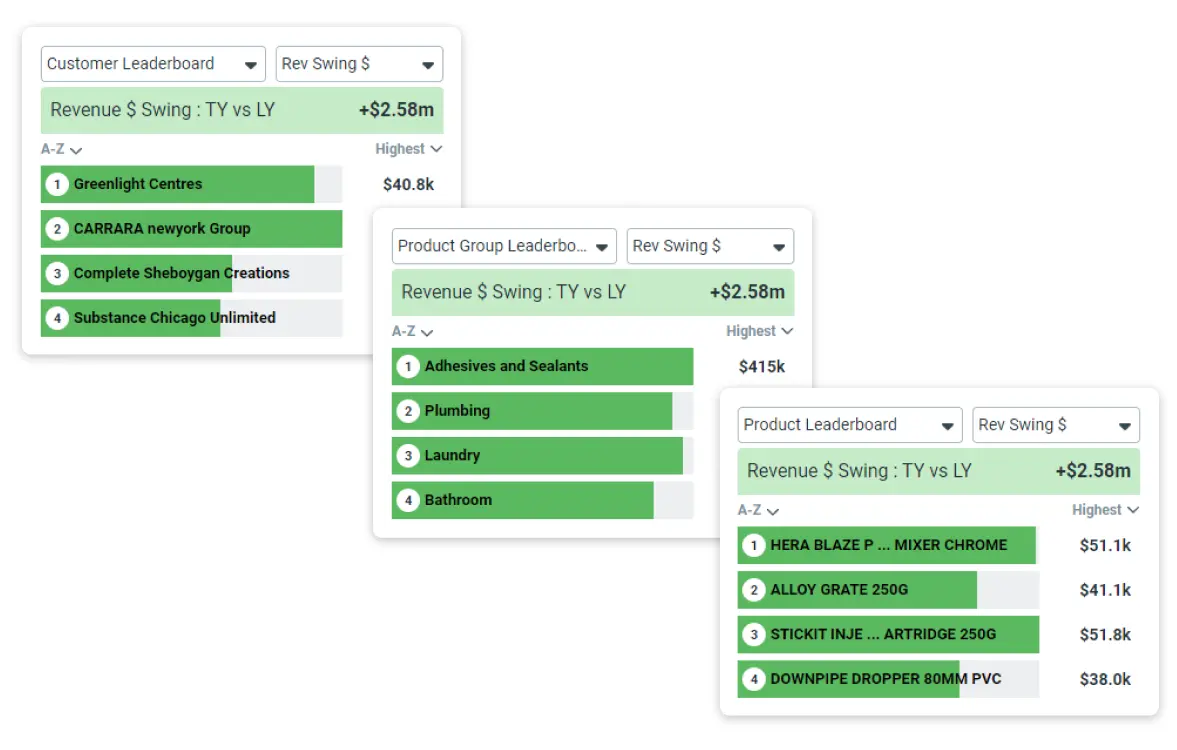
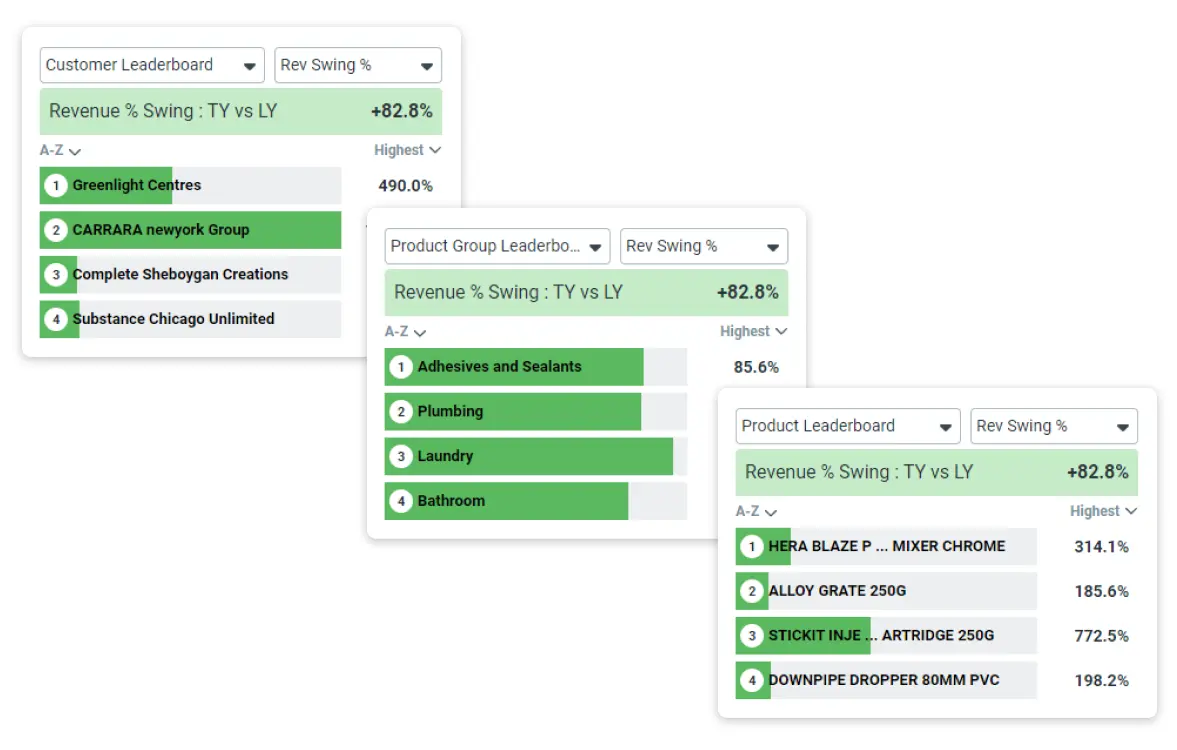
Revenue Swing $ and % are important because they show sales reps which customer, product groups, and products are experiencing change, allowing reps to take action without the admin. In a practical sense, Revenue Swing $ and % can act as troubleshooters: if there is a larger issue, a rep can drill down until they’ve found the problem’s root cause. From there, they can get in touch with their customers to ask them what’s been going on with their projects to cause said growth or decline.
For example, after looking at Revenue Swing $ and seeing a customer $3,000 behind vs last year, a sales rep can drill down into the product group level to see which groups have led to the decline. By going further, into the product level, the rep can see exactly which products have caused the decline. From that drilldown, the rep can start taking action, whether that be to book a customer meeting, have a phone call, or send an email. Perhaps the customer stopped buying a popular product as they’re facing a new problem. Could there be an opportunity to win back their business by recommending or cross selling the customer into a more suitable product?
Furthermore, unlike your conventional BI tool, sales reps don’t have to sift through data on their laptops to identify these growth trends at every level. With Numerik, Revenue Swing $ and % are updated by the minute and can be accessed straight from a phone in under 15 seconds.
To drive sales performance and start customer conversations, we recommend you get familiar with the following 5 points
In sales, there’s very little time to take action and customer sales performance can change quickly. Using Revenue Swing $ and %, sales reps can quickly see which customers, product groups, and products are behind year on year, without wasting time. Before you go, let’s re-cover the basics:
Want more information on how your sales reps can use Numerik’s sales metrics to drive sales? Click here to book a fully personalized demo. Alternatively, if you’re a current user looking for more help, don’t hesitate to message the customer team at support@numerik.ly.

Solving disengagement among your sales reps cannot be understated: you don’t want to be waiting for resignations before treating, what is now, a prevalent workplace problem. According to Mike Stokes, only 20-35% of employees are engaged in their roles: as a sales manager, it’s on your shoulders to get those remaining 80-65% of sales reps back on the rails. To give you some inspiration, we’ve gathered 3 tactics you could use to combat disengagement in your sales team. Let’s have a look.

Instead of aiming for work-life balance, it’s better to help sales reps achieve better work-life alignment, particularly if they’re in the 25-45 year old bracket.
What’s work-life alignment? According to a 2022 Harvard Business Review article, work-life alignment is about how your work compliments your personal life in both a practical and psychological sense. If a sales rep feels as though their work is detracting from their life, they’re not going to be happy or engaged about working.
To work out where your mid-career sales reps stand on work-life alignment, you’re going to need to set aside a good 30 minutes to ask your reps a few questions individually.
When asking questions, you might not get the full answer on the first try, lead with openness and empathy, and you’ll uncover their pain points.
It’s no good asking why sales reps have chosen to leave when they’re out the door: while they’re still on board, you could instead ask them what’s making them stay. In SalesHitch Episode 2, sales leadership development specialist Mike Stokes spoke on how sales leaders can combat disengagement using simple stay interviews.
What are stay interviews? These interviews are used to discover what’s encouraging your reps to stay with the company, and what they’d like to see changed. They’re a great way to uncover pain points, and begin the process for company change.
If you’d like to start running stay interviews, check out the infographic below for potential questions you can ask during a 15 minute chat.

As a sales manager, you won’t always have time to give 1-on-1 coaching, a few hours a week, for an entire sales team. Instead, save time by setting up a sales mentoring program.
What is mentoring? Mentoring happens between two people, usually in similar roles, where the mentor helps the mentee refine their skills and grow their career. It can be an efficient way to help less experienced sales reps upskill, and can be very gratifying for the mentor.
According to 2018 and 2022 Forbes articles, it’s best to keep the following points in mind when setting up mentoring:
Re-engaging sales reps takes dedication, be prepared to have patience and make time to have conversations and build mentoring relationships: start by finding 30 minutes. To recap:
Harvard Business Review, 2022, How to Re-Engage a Dissatisfied Employee, by Laura Gassner Otting.
Forbes, 2018, Be One, Get One: The Importance of Mentorship, by Alyssa Rapp.
Forbes, 2022, How To Mentor With Intention, by Jae Sook Evans

Sales forecasting can be tricky to perform accurately if you aren’t used to it, whether you’re forecasting with paper, spreadsheets, or even Numerik! With economic instabilities, global crises, and supply chain issues affecting your customers’ spending, maintaining sales forecasts can seem pointless. Keep persevering! An accurate sales forecast gives you a precise path to reaching sales goals, tracking your personal sales performance, and provides an early warning system when revenue starts slipping.
In this blog, we’ll look at how you can run better sales forecasts in Numerik to ensure you make your number. Scroll down to see our video guides and get started.
You can’t become a sales forecasting pro if you can’t locate your forecast quickly. Follow the simple workflows below to find your sales forecast quickly in Numerik.
There are two ways to find your sales forecast. When you load up the app, you’ll find yourself on the homescreen with your scorecards and target cards. From here you can access sales forecasts by tapping “Forecasts” on the top right, then selecting a current or future target you’d like to forecast for. Now you can forecast revenue against your customers.
Alternatively, if you’re already in the grid, provided you're in the customer dimension, you can see your sales forecast by switching the metric to “Forecast.” From here you can adjust your forecasts.
Having your sales forecast close and quick to access makes it easier to include forecast updates into your routine. If you can find your forecast without thinking, you’ve got the right foundation.
Keeping up with your customer’s changing requirements throughout the period can turn sales forecasting into a chore. Here’s what you can do in the Numerik app to proactively stay on top of your forecasts:
Numerik’s in-app sales forecasts use (-) and (+) buttons to quickly subtract or add dollars in relative increments: great for when you’ve only got 3 minutes to mash a number in before a team meeting. If you’re needing greater accuracy, you can tap the forecast figure to manually change it.
Good sales forecasts can’t be maintained without a proactive approach. Your sales forecast can’t warn you if you’re going off course if you aren’t updating that forecast and planning preemptive actions when customers fail to meet their forecasted revenue. Salespeople who make efforts to update their Numerik sales forecasts after connecting with customers and making sales can relax knowing their forecasts are accurate and they know where they’re going.
A simple tap of the (-) or (+) buttons and glimpse at your Forecast Tracking could mean the difference between meeting sales targets or not: make efforts after each client meeting to review your forecast.
Without context, sales forecasts are nothing more than numbers: in Numerik, you can easily keep notes on all your sales activities, and forecast changes, using Posts. Noting critical forecast-related details could help keep you a step ahead, ready to jump on sales opportunities.
If you use Posts, you’ll be familiar with writing notes, uploading photos, recording video and capturing audio to save against your customers after calls, meetings, and store visits. The same workflow applies to sales forecasts.
After adjusting a customer’s forecast, tap their name and scroll down to “Actions.” There, you’ll have the option to “View Posts.” Tapping “View Posts” takes you to all the Posts recorded against the customer, and on the bottom right, you can create another.
In your Post, you could elaborate on why you’ve changed the forecast. A customer might be ready to proceed with a new quote, or show interest in ordering more. Perhaps you recently spoke to them and know they’re starting a new project. Maybe you need to note an Opportunity or a Task: an opportunity to earn more, or you need to follow up with the customer to keep on track. Additionally, if you’d like your team or manager’s feedback, you could add your manager to the post using the @ mentions feature. If it can help you plan your next move, expand on your forecast with a Post.
Sales forecasting can help you get perspective, clarity, and direction when you need it most. To build a better forecast which helps you make your number, you’ll need to include forecast updating into your routine, be comfortable making quick forecast changes, and build nuance with notes.
Next time you’re interacting with your forecasts in Numerik, ask yourself these questions:

Streamlining sales team communication requires concentrated effort, dedication, and the right tools. Unfortunately, improving communication takes time, and in sales, time is a luxury.
In this blog we’ll discuss how you can fast track sales team communication quickly using Numerik’s Posts feature.
What makes communication ‘good’ depends on context. For our purposes, we’ll look at three general concepts critical to good business communication.
The communication’s core message is easily understandable:
Core messages can usually be explained with a few sentences: if simple concepts take paragraphs to explain, have a rethink. Try reducing information down to its core message. Your message should be easily understood without using a dictionary or reading an essay!
Everyone who needs to see or hear the information receives it:
Information is useless if it doesn’t reach the recipient. Ensure you use channels which your recipients are active on. Alternatively, if the information is urgent, reach out to recipients on their preferred channel individually: adapt to what others need/respond to.
Everyone is receptive to communication:
Being receptive to communication means paying attention to what others are saying: you never know when it might be important or affect the way you operate. Receptive people make efforts to process information and keep an ear to the ground.
Numerik’s Posts are a tool for capturing customer information in a social media style which allows for easy sales team communication in a sales context. Using mixed media, reactions, comments, mentions, and the Team Posts feed, app users can communicate with colleagues in one place. For example, if a sales rep wants advice from their manager or colleagues, they can share their Post to Team Posts, where everyone can view, comment, and react to it with emojis. Additionally, users can use mentions to bring someone new into the conversation, a feature which notifies the mentioned user ensuring they don’t miss out.
Posts can help you streamline your sales team communication because they allow information to be shared flexibly and to the right people. Pictures, video, and audio give sales reps flexibility in how they communicate, rather than confining them to typing. Using mentions, and the Team Posts feed, reps can ensure their communication is being seen by the right people. Additionally, with multiple emoji reactions and comments, it’s easy to engage with your reps’ Posts to give advice and praise.
Based on the three communication concepts, let’s see what you can do to streamline your sales team’s communication using Posts.
Vague or rambling Posts aren’t effective ways to communicate a message. If your reps’ Posts are difficult to understand, or they’re struggling to communicate their message, ask them to simplify what they’re trying to say into one or two ideas.
Make sure your sales reps know how to get their Posts seen and heard. Using the new mentions feature, any user can tag their colleagues or their manager, who will receive a notification.
Communication isn’t one-way: everyone should make efforts to be receptive and interact with Posts. Build a proactive habit by encouraging sales reps to spend time reviewing the Team Posts feed, reacting, and leaving comments each day. Sales managers particularly could consider making efforts each day to react and comment on sales reps’ Posts to help increase engagement and praise reps for their work.
Don’t forget that improving communication takes consistent effort. Start gradually by selecting one area for your sales reps, and yourself, to work on for 2 weeks: it may be checking mentions, finding better ways to get messages across, or building a better Post routine.
Streamlining communication within your sales team can be fast tracked if you’re using an engagement focused tool like Posts. Cementing a higher communication standard amongst your sales team with Posts may take time: Healthline says it can take on average 66 days to form a habit. Start building better communication habits with Posts by:
If you’d like to hear more about how Posts can help your sales team, you might like to check out this blog on how Posts increase sales rep engagement.

Need a quick and simple way to drive your sales performance and get your sales tracking back on pace? Whether you’re an Excel pro, or living with a sales CRM, it’s likely you’ll benefit from a simple sales tool: the paceline.
Read on to learn how pacelines work, why they help drive sales performance, and how to build your own in 3 steps.
A paceline represents where a sales rep’s or sales team’s sales should be each day to meet that period’s sales target. It’s a sales tracking tool which can show reps and managers exactly how sales performance is tracking at the granular level: day by day.
Pacelines can be represented by a graph, or as a percentage as shown in the example below.

In your paceline, it’ll be easiest to use the Ahead Of Paceline percentage. If you’re struggling to envision the paceline, its closest relative is the world record graphic seen on Olympic swimming broadcasts:

The swimmers are salespeople, and the world record line marks where each individual should be if they want to hit that target.
Paceline: A sales tracking tool which shows salespeople and sales leaders where they or their team need to be each day to meet a period’s sales target.
Pacelines drive sales performance by showing sales reps if their current sales performance will be enough to meet their sales target.
Typically, sales teams and reps know how many sales have been made, but can’t easily identify if they’re on track to meet target, or what they’ve got to achieve each day to get there.
Dividing the target into daily goals and tracking performance against the goal creates direction and transparency, showing reps exactly what they’ve got to do. Removing the mystery from sales using a paceline helps salespeople stay agile on their feet and focused on where they’re going.
Additionally, pacelines can help sales reps recognise dips in their sales performance, acting as a warning system, giving reps time to get back on track.
Pacelines drive sales performance by acting as mini sales targets, helping salespeople stay focused on where they’re going, and get back on track when their performance dips.

If you don’t use a sales performance app with automated pacelines, you can still make one. Drive your sales by using the process below to make a simple manual paceline.
Step One:
Create your daily paceline by picking your sales target for the period, or if you’re a sales manager, the team target, and breaking it down into daily amounts. Make sure you don’t count weekends or public holidays when you/your team won’t be selling.
Example: Your selling period is 22 days long, and your target is $118,000. Your daily paceline is calculated as: 118,000 / 22 = 5364. 5364 is your daily paceline.
Step Two:
In a spreadsheet create three columns: Daily paceline, actual sales, and variance. These columns are your scorecard. At each day’s end, record your actual sales next to the daily paceline, then calculate your variance to the paceline. In three days, you’ll start to notice a pattern: are you ahead or behind the daily paceline?
Example: ($4200 sales made / $5364 daily paceline) *100 = 78% aka 22% behind the paceline.
OR..($6450 sales made / $5364 daily paceline) *100 = 119% aka 19% ahead of paceline.
Step Three:
If you’re consistently falling behind the paceline, think about what could be causing the sales performance drop. The trend could prompt you to reach out to customers who’ve been ordering less, or to begin finding new customers through referrals.
If you’re a sales manager, post daily paceline variance into your Slack, WhatsApp, or Teams chat to show your sales team how they’ve performed for the day, and the growing performance trend. Additionally, creating a sales rep leaderboard with everyone’s daily paceline variance could help spark conversations and competition.
Building a paceline can help sales reps get a better handle on where they’re at, and where their sales performance needs to be to achieve their sales target. If you have 10mins spare at the day’s end, you can easily adjust your paceline and take actions needed to improve sales results. Remember:
Pacelines can be as simple as you like, however, the recipe we’ve given above doesn’t take into account seasonality. In a sales performance app, pacelines are more complex and include external factors contributing to seasonality: keep this in mind when you’re making your own.

Motivating your sales team takes time and requires a thoughtful approach. To deepen our understanding, the Numerik team spoke with Mike Stokes, CEO at sales leadership development organization Indicator, where he shared his approach to engaging salespeople in their work and uncovering their motivators.
What drives salespeople to stick with their roles? How do you find out what motivates salespeople? What process should you use to motivate a sales team? How do you retain your best salespeople and keep them motivated? Read on to get the answers.
Salespeople aren’t compelled to stay in their role purely for a good commission. Citing Indicator’s 2022 salesperson mood of sales survey, Mike explains there are 6 reasons motivating salespeople to stay in their roles:
1st equal= Love of their company.
1st equal= Skill set development opportunities.
2nd= Company culture.
3rd= Their clients.
4th= Love of the industry.
5th= Remuneration.
Based on data gathered from New Zealand salespeople, these 6 reasons could help sales leaders reconsider how they motivate their team. If a salesperson’s love of their company and desire to develop their skills are key drawcards, what could you do to foster their engagement and up their game?

Sales leaders can’t start taking actions to boost their sales team’s motivation without understanding what motivates each salesperson. Discovering what motivates your sales team can be done quickly using three questions:
1: What is the most important thing in your career or your role (list)?
To uncover what really motivates your salespeople, you’ll need to push hard. Often, your salesperson’s top motivator won’t come out first: keep asking “what else motivates you?” and add each new motivator to the list.
Alternatively, you can phrase the first question as “what do you value?”
2: Which one of these is the most important to you (order)?
To order the motivator list, push your salespeople to explain why each motivator is important to them. Keep working together to shape the order, taking time to discuss and double check each motivator’s ranking.
3: Why is this so important to you?
Choose the highest-ranked motivator from the salesperson’s list and discuss why it’s important to them. Drilling into the “why” can help you discover exactly how your salespeople become motivated, which you can draw on to adapt your leadership style.
Mike explains there are seven common motivators sales leaders may uncover when asking these three questions, including:
Based on the motivators you collect from your sales team, you can start making decisions about how to change your sales leadership to better motivate your salespeople.
The motivation process begins at the individual level. Individually, sales leaders can talk with their salespeople to understand what motivates them. After uncovering their motivators, sales leaders can take steps to alter their leadership for each individual.
Tailoring leadership to the individual takes concentrated effort. Mike recalls an experience he had with an extremely driven salesperson. The salesperson wanted to lead their team by over 30%, while their team was motivated by seeing how their combined efforts were impacting the business. Helping the competitive salesperson quantify and track their performance against their colleagues was a key step Mike took to motivate and engage the salesperson in their role. If Mike had overlooked the salesperson’s motivators and focused on motivating the team as a whole, the salesperson may not have reached their full potential. Each salesperson is motivated in different ways, making majority-rules approaches less effective.
To complete the motivation process, sales leaders can explain to their salespeople how each individual’s work meaningfully contributes to a wider team goal. If the team goal is to earn over $30 million in revenue, how can you make every $1000 meaningful?
To retain and motivate your salespeople, sales leaders can continually improve and adapt their leadership style and work environment to suit their salespeople’s motivators. However, unless leaders regularly check-in with their salespeople, they won’t know where changes should be made until it’s too late. Mike recommends using stay interviews to regularly check in with salespeople.
Stay interviews are short individual conversations sales leaders have with their salespeople to understand what each salesperson is liking about their role, why they’re staying, and what could be changed to lengthen their stay and improve their role.
If you’d like to run a stay interview, you can use the infographic below as a guide:
Sales motivation isn’t something sales leaders can create overnight. Cultivating sustainable motivation in a sales team starts at the individual level and is ongoing. Let’s recap your main takeaways:
1: Salespeople are motivated to stay in their roles out of love for their company, potential development opportunities, company culture, their clients, love of their industry, and remuneration.
2: To uncover what motivates your salespeople, ask these questions: what is the most important thing in your career or role? Which of these is most important? Why is this so important to you?
3: To motivate all sales team members, you can start by a. Understanding what motivates each person, b. Tailor your leadership to their motivators, c. Explain how their work meaningfully relates to wider goals.
4: Retain your salespeople and sustain motivation by taking time to hold stay interviews.
This blog was inspired by the stories and advice shared in SalesHitch Episode 2 by Mike Stokes. Discover Mike’s process for building sales engagement in your sales team in this article here.

In 2021, Scott Edinger wrote for the Harvard Business Review that referral selling is one of the best strategies salespeople can use for increasing sales, more likely to succeed than other techniques, and essentially free. So, why aren’t we all using referrals to make our number each period? Unfortunately, getting referrals in B2B sales isn’t straightforward - your B2B referrals will only work if the right conditions are met, and you ask correctly. In this blog, we’ll look at what’s needed for B2B referrals to succeed, how to ask for referrals, and the “don’ts” of referral selling.
#1: Long-term relationships with happy customers.
If you want to get B2B referrals when you ask for them, you’ll need to have at least one ‘strong’ relationship with a customer. What constitutes a ‘strong’ customer relationship? These are the customers who’ve been with you long-term and have consistently experienced your initiative. With these customers, your word is your bond, and you’ve been making their job easier ever since you became their sales rep.
With this strong relationship as a foundation, when you ask for referrals, the customer is more likely to want to give back to you and spread good words: you want to be referred to potential clients in the most genuine, heartfelt, and honest way possible! Do you have long-term customers who feel this way about you?
One way to check if you’ve identified a good customer to ask for a referral is to check if your track record with them is spotless at all levels. If the customer made an order, but had frequent delivery hold ups, or their accountants had a nightmare with invoicing, it may be best not to ask them for a referral.
#2: Have relevant customer information on hand.
When you’re preparing to ask for referrals, make sure you can access your customer information. Know what they’ve been working on, the transactions they’ve made with you, and their buying process. Additionally, if you have other contacts within the customer company, check in with someone who knows your primary contact, and ask whether the primary contact is open to giving referrals.
#3: Have good timing, and pick your moment.
Before you ask a top customer for a referral, make sure to: A. Find out the best time of day to ask, and B. Check that the customer is in a good mood. It’s pointless to send a referral request out on a Friday afternoon, or on a Monday at 5pm: take care to pick a productive time. Additionally, if your customer has had a terrible week, is too busy to talk with you, or isn’t as receptive as they usually are, don’t ask for a referral. Ask for a referral when they’re in a good mood and you’ve got their full attention.
Let’s not over-complicate things. When you ask a customer for a referral, there are 3 things you should keep in mind:
Knowing what’s needed to give referrals the best chance to succeed and how to ask for them, we can look at what NOT to do.
As much as we like to think, referral selling can’t be automated: it’s a strategy which requires a personal approach based on strong relationships. To recap, you can up your referral game by:
If you’d like to learn more about what you can do to strengthen customer relationships, you might like to check out our recent webinar event with Liz Heiman.

Keeping a sales team engaged is a sales leadership fundamental: a salesperson’s willingness to get up and fight for sales must be sustained. Unfortunately, without a strategy for building sales engagement, sales leaders may struggle to retain their sales people; no one enjoys exit interviews!
However, unbeknownst to some sales leaders, despite their good intentions, it’s their behavior which can cause the most harm. In this blog, we’ll look at two clear signs you’re disengaging your salespeople, and a simple solution: the stay interview.
Prevention is the best medicine. Before we explore our cure, let’s unpack two common behaviors sales managers perform which contribute to sales team disengagement.
“To me, micromanagement highlights that a sales leader doesn’t trust their people” Mike Stokes
A micromanager is someone who manages situations, or their employees, with excessive control while fixating on small details. Micromanagement is a fairly common behavior, stemming from a very human condition: distrust.
We’ve all got a memory of a time where we trusted another person to do something for us, and it didn’t work out: why didn’t I keep an eye on them, I should’ve done it myself! Yes, sometimes it’s best to give more guidance, or do things ourselves. However, constantly overseeing others, or refusing to delegate tasks isn’t sustainable. You should trust the people you work with that they’ll do their best and give them enough guidance to achieve goals without interference.
Recalling his past, Mike Stokes, founder of sales leadership development firm Indicator, shares his own experience with micromanagement. “One of the things I used to recognize was when I’d go out on calls with salespeople as their manager, I would be too eager to jump in and fix the problem.” Despite positive intentions, Mike’s old behavior made his salespeople nervous, and prevented him from properly developing their skills. “We need our salespeople to take some initiative: you’re going to have to let them fail a few times.”
“Give them that praise. If there are things going wrong, have those discussions, but don’t forget the praise element.” Mike Stokes
Correcting a person when you’re teaching them a new skill is natural: how else would you expect them to know when they’re doing it wrong? However, Mike argues corrective feedback isn’t the most effective teaching tool. If you want to efficiently embed new behaviors, it’s better to lead with praise.
Everyone needs correction once in a while, but giving too much correction can harm a sales person’s motivation. If we’re always told we’re not doing something right, it’s much easier to give up and try our hand at something we’re more suited to. Giving feedback, whether correction or praise, is about being there to support your salespeople and develop their capability, not wear them down. “The most important thing that salespeople want from their sales leaders is they want to know they’ve got their back.”
Stay interviews are short 1-on-1 conversations sales leaders can have with their sales people to discover why they’re staying in their role, and what could be changed to improve their work experience. If a sales leader is suspecting disengagement in their sales team, a quick 20 minute stay interview is a simple way to learn what’s working, and what isn’t.
Mike explains “we are now very encouraging of stay interviews… if you can start having those conversations early, you can start to pick up on those red flags.”
Unsure where you should start? Check out the infographic and Mike’s question list below:
Starting out: I love what you’re doing, we see you as a critical part of the business and we want to keep you engaged.
Don’t wait until your salespeople are coming to your office for their exit interviews. Retain your best talent and build engagement by:
This blog was inspired by the stories and advice shared by Mike Stokes for SalesHitch Episode 2. Learn more about Mike’s process for building sales engagement in your sales team in this article here.
.webp)
Sales forecasts are critical for setting expectations, guiding team efforts and gauging performance against growth targets. While spreadsheets provide basic projections, solutions like Numerik introduce process enhancements that boost accuracy and convenience.
Let's explore fundamentals around building a sales forecast and how modern platforms streamline this essential activity.
A sales forecast estimates expected revenue or unit sales for a given period. It represents a data-driven prediction to inform operational decisions and provide performance visibility.
Effective sales forecasting delivers several key advantages:
Accurate forecasts clearly pay dividends across revenue generation, opportunity progression and capability building processes. Now let's explore core techniques.
Start by clearly defining the total sales revenue expected over your chosen timeline – whether tracking annual recurring revenue, total contract value or transactional volume. Document this formally as your official target.
Then make a list of existing customer accounts and contacts that will contribute toward achieving that revenue goal based on historical precedents or contracted commitments.
For example:
Target revenue for Jan-Mar 2023 = $30,000
Existing customers:
This consolidated first step establishes (1) the revenue target to guide activities and (2) the customer roster to strategically focus efforts for efficient progression.
Now split up your total target revenue from Step 1 and allocate specific amounts to each customer. Assign values based on:
Make sure the sum of all customer revenue allocations equals your original total target.
For example, for a $30K Q1 target:
Total expected from mapped customers = $30,000
This breakdown indicates how much revenue you expect to source from each customer account. It allows concentration of effort toward the highest potential opportunities.
Now construct a dated timeline for achieving your target revenue mapped to each customer (from Step 2). This schedule should align deal progression milestones to your average sales cycle length.
Plug in expected revenue amounts on dates when you foresee securing commitments from each customer based on historical closing rates. This highlights windows requiring pitch meetings, contract approvals, etc.
Additionally, the timeline presents opportunities to push for expanded revenue potential from strong fits by planning additional touchpoints.
For example, to hit a $30K March target:
Here is what a dated revenue timeline might look like in this scenario:
The timeline drives proactive planning to progress top opportunities through sales stages by key dates. Adjustments then redirect efforts to counter potential shortfalls.
As the sales period progresses, variances between projected and actual revenue will emerge across customers. Continually revise initial forecasts up or down per the latest result signals.
For example:
Updating initial projections preserves accuracy as market conditions shift - keeping teams focused on the best opportunities. Solution like Numerik automate this through direct data feeds that instantly reshape forecasts without manual manipulation.
Over time, fine tune processes to enhance predictive precision. But don’t permit forecasts to stagnate without regular adjustments - lack of updated visibility risks teams missing alerts that targets require urgent nudges until too late. Maintained accuracy provides clear direction even amid turbulence.
Purpose-built for sales teams, Numerik centralizes CRM data into an intuitive mobile interface. This allows effortless creation and adjustments of segmented forecasts tied directly to customer lifecycles and product categories.
Key features include:
Don’t rely on rigid spreadsheets. Elevate sales forecasts with Numerik for enhanced visibility, convenience and team alignment – driving growth targets with minimized risk.
Request a demo to discover how Numerik can transform your sales forecasting process. Or, for more sales tips, check out our blog on what to include in a top-tier sales deck.
.webp)
There are dozens of techniques sales leaders can use to improve sales team effectiveness- almost too many to count. To cut through the noise, Numerik CEO Jonathan Hubbard and I recently caught up with Mike Stokes, CEO at B2B sales leadership development organization Indicator, to get his advice.
In this blog, we’ll unpack Mike’s approach to developing sales team effectiveness by using praise and understanding the flow state.
A disengaged sales team is lethargic, unable to reach great heights, and their sales performance may be reaching a plateau. In that situation, it’s important to remember that sales team effectiveness, and the level of commitment to their work and company is linked.
In reality, few individuals in a sales team are truly engaged in their work- only 20-35%. Additionally, based on Indicator’s 2022 salesperson survey results, potential development opportunities are one of the main reasons salespeople stay engaged in their roles. Mike explains that if sales leaders want to increase their sales team’s engagement and effectiveness, they need to be given these much-wanted development opportunities: “it’s a really important thing for most people… they want to develop themselves and push themselves.”
A highly effective sales team is an engaged sales team. Fulfilling a salesperson’s need for development opportunities helps them become more efficient and engaged. To successfully develop salespeople while keeping them engaged in their role, Mike encourages embedding with praise, and understanding how to move salespeople into their flow state.
Once you’ve chosen an area to develop, Mike recommends using regular praise, rather than corrective feedback, to embed successful sales behavior. To illustrate the point, Mike shares a story from a colleague’s university days as a psychology student working with pigeons.
The students’ goal was to train a pigeon to walk in a clockwise circle. However, rather than waiting for the pigeon to walk in a full circle and then reward it, the students would reward the bird every time it walked in the right direction. Eventually, the pigeon could easily walk a clockwise circle.
The same principle can be applied to a developing salesperson: rather than wait for a big outcome from a new behavior, praise the small achievements. However, corrective feedback is still necessary: it’s simply the frequency of the feedback which needs changing. Mike suggests that for each corrective feedback, there should be five pieces of praise. The regular praise helps reinforce the successful behavior in the salesperson’s mind, helping them learn more efficiently. Besides increasing learning efficiency, the 5:1 praise/feedback ratio shows the salesperson their leader has their back, and is there to help and support them.
While developing salespeople, Mike encourages sales leaders to discover where each salesperson’s flow state lies, and to gradually develop them into a constant position in that state. Flow state refers to a state of being where you feel 100% immersed in what you’re doing, able to work at peak performance with clear focus and awareness: it’s something anyone can achieve with the right guidance. For salespeople, Mike explains that their flow state can be found in the intersection between skill level and challenge.

To achieve flow state, the salesperson must be challenged according to their skill level. Mike explains “if their skills are really high, but the challenges of their role are really low, they’re going to be bored. Opposite to that is if their challenges are really high and their skills are low, they're going to be in a high level of anxiety.”
Thinking about where salespeople lie on the boredom-anxiety spectrum can help sales leaders make better choices about how each salesperson should be managed and developed. Highly skilled salespeople in roles without enough challenge may need to be moved to a different role or handed a more difficult project or customer to manage. Conversely, if a salesperson is in over their head, facing challenges they aren’t prepared for, they may need a role change, or one-on-one coaching.
Improving the effectiveness of a sales team ties closely to the team’s engagement and their desire to improve. By enhancing sales team development with regular praise and aligning each salesperson in their flow state, sales leaders can begin increasing team effectiveness. To successfully develop sales team effectiveness, remember the following:
This blog was inspired by the stories and advice shared by Mike Stokes for SalesHitch Episode 2. Learn more about Mike’s process for building sales engagement in your sales team in this article here.
.webp)
Sales engagement is a measure of a salesperson’s commitment to their work and their company. If you want to maintain a hard-working healthy sales team, you’ll need sales engagement: without it, you’ll be holding more exit interviews than ever before.
In this blog, we’ll explore why Numerik’s Posts feature can dramatically enhance a sales team’s sales engagement, with discussion from the Numerik team and our users.
Posts are a social media style feature which allow salespeople to capture notes, videos, audio, and pictures, save them as notes against customers, and share that content into a team feed. What this creates is a melting pot, combining rep-friendly CRM customer notes taking and a WhatsApp or Slack sales chat: business productivity meets social culture. The biggest difference? Posts are free from the chore ingrained in CRM note taking and keeps the conversation within a sales context where critical sales data is literally one tap away.
According to Mike Stokes, CEO at sales leadership organization Indicator, giving salespeople the right amount of praise is a simple way to nurture sales engagement. For episode 2 of SalesHitch, Mike explained that sales managers shouldn’t wait to give praise for big achievements: small wins should be praised too. The ideal praise to corrective feedback ratio should be 5:1, a frequency which shows salespeople you care about the work they’re doing, and have their backs.
If you’re struggling to find ways to naturally give praise or interact with your salespeople, Posts could be your solution. A core principle of Posts is making celebration easy.

When salespeople share a win, no matter how small, a sales manager can instantly give praise: reacting with emojis, or writing a quick encouraging comment. Unlike your Slack chat, salespeople don’t have to scroll back for miles to find that win or praise, with each post saved under a certain customer, all communication is kept in one place.
It’s one of sales’ most unrelenting problems: getting salespeople to upload customer notes into the CRM. For most salespeople, uploading notes is a boring time-sink, nothing more than a tick-box exercise with little productive value. Consequently, CRMs create disengagement: there’s nothing more demoralizing than spending 30 mins at the end of your day retyping notes knowing no-one will read them.

Posts aren’t just a tool for celebration, they’re a customer notes record, a space for salespeople to record visits, opportunities, tasks, customer information, and anything else they’d like. Each Post is created against a customer, allowing a salesperson to view a complete customer notes history whenever they’re looking through a customer’s sales data.
Unlike your CRM, Posts are made to make note taking quick, flexible, and engaging. Salespeople aren’t limited to retyping their notes: if they’d prefer to take a picture or screenshot of their notes, record an audio clip, or take a short video, they can.
It’s easy to become disengaged if you’re feeling isolated from the rest of your company, particularly its leadership. In 2022, Indicator found that the number one reason salespeople stay in their roles is their love of the company. If you’re feeling as though company culture is beginning to impact your team’s engagement at work, it may be the time to introduce a more open and friendly approach to communication.
In Posts, communication isn’t limited to a single sales team: any approved user can read or interact with a post to share their encouragement or support.
Robbie Dale, National Sales and Marketing Manager at Farmland Foods explained that even their CEO gets involved: “The engagement at every single level is incredible. Eddie Davis our Managing Director is on Numerik, commenting, giving thumbs up and awarding trophies. You know when the senior leadership team gets involved you’ve got something fantastic.”
Sales engagement isn’t easy to generate or sustain. However, with new sales tools being released every year, and several companies being technologically behind, now is a great time to discover a tool which could make building sales engagement easier. In summary, Posts help enhance sales engagement by:
This blog was inspired by the stories and advice shared by Mike Stokes and Jonathan Hubbard in Episode 2 of SalesHitch. If you’d like to learn more about Mike’s process for building sales engagement in your sales team, you might like this article here.

The Numerik Index is your quarterly sales performance benchmark report, created to give you a wider perspective on how you stack up against your peers and all Numerik users.
We’ve been working on it for the past few months and are very excited to be giving you the first look: let’s dive in!
Watch Jonathan’s interview to discover what the Numerik Index is, why we made it, and its benefits, or scroll down to read the full summary.
The Index is a free report sent out to Numerik users each quarter which shows you a snapshot of your growth for the quarter, your company’s performance, and how you compare to Numerik’s user base as a whole.
“The idea behind it actually came from the way that school reporting works, where students are able to see how their marks compare to other students in their school and in their state.”
Here’s an example of what your Index may look like:

What each aspect means:
“It gives you that really good view of where you sit compared to your company and where you sit compared to other Numerik users.”
We decided to create the Index to help our customers understand their sales performance from a different perspective:
“At the end of the day, Numerik’s about managing the numbers, helping people succeed and improve their sales performance.”
From our point of view, the Index shows us how our system is making a difference to your performance.
“From a reps perspective, we've found it's very interesting to know how you compare to other reps. Salespeople are competitive by nature, and it’s super interesting to see your performance and sort of compare that to other users.”
In addition to giving competitive insight, the Index acts as a snapshot in time, creating a performance record. As new reports are sent out each quarter, you can begin to build up a performance history, and see your progress on a larger scale.
Keep a close eye on your inbox: your Index will be emailed to your Numerik user email address once per quarter.
Each Index includes one full PDF report and a simple infographic for sharing among your team, or wherever you’d like.
Not only does the Index show us a snapshot of rep performance, it reveals surprising sales performance trends at regional and industry levels. We’re very excited to dive into the data and explore what these trends say about the sales landscape, coming in our second release.
For our second Index release, Jonathan and Connie will break down the Index’s wider-reaching discoveries, with an extra report and commentary. They’ll explore what the Index’s findings mean for each industry, and discuss regional results to give you more context on how your sales performance stacks up. If you don’t want to miss it, keep an eye on your Inbox this October!

“Be curious about your people, what drives and inspires them. Make them better: create individualized development plans and praise any of those things that they're doing well. Provide them with the best tools to do the job, trust your team, give them an opportunity to fail. And most importantly have fun.” As he summarizes his discussion, it's clear that Mike Stokes has no shortage of sound sales advice. That’s to be expected: Mike’s the founder and CEO at Indicator, a B2B sales development organization serving Australasia.
Mike joined Numerik CEO Jonathan Hubbard and I for SalesHitch Episode #2, where he shared his approach to growing sales engagement in the modern B2B sales team based on his experience working with companies to improve their sales capability and revenue.
Watch the video below or read the summary to get Mike’s 3 ways to grow sales engagement, stories, and thoughts on reducing disengagement.
We’ll start off with a question: if your sales machine (people, technology, processes) was a boat, what boat would it be?

“Are you the America's Cup yacht of sales? Meaning do you have the best technology? Do you have the best team? Are they trained within an inch of their lives? Do they know exactly what they're doing with any certain type of material?”
Not many of us quite fall into the America’s Cup category. Perhaps you’re a “an old trusty [sailboat] you’re going to get from A to B, but you’re not going to do much else. You might be lucky to have a little technology on board, but you’re not going to win any races.”
And at the bottom of the heap: “or are you pretty random? You’re doing things all over the show. There’s no consistency. You just don’t know what you’re doing in sales.”
What does this anecdote have to do with sales engagement? It’s illustrating the idea that salespeople want to work for companies who have the best systems, technology, and processes: the America’s Cup yacht. And your responsibility as a sales leader is to find ways to build your people, processes, and technology into being the ultimate sales engine: something impossible without good sales engagement.
Sales engagement is the level of a salesperson’s commitment to their work and to their company. Without good engagement, your sales team can become lethargic, unable to reach great heights, and your employee churn rate may increase. Mike explains that 20-35% of employees are actually engaged in their work, “think about your team: four out of five of your team are not engaged in their work, which is a pretty critical number.”
However, if you have good sales engagement, you can expect, according to a Gallup survey:
Extending on these findings, Mike shares Indicator’s 2022 salespeople survey results, which revealed insights into what drives a salesperson to stay with their company:
“One of the questions we asked these sales people is what is the number one reason why they stayed or why they stay in their role. The top three are, they love the company and developing opportunities, which were actually pretty even… company culture being third.”

These results give a broad overview of what managers can keep in mind to keep their team engaged. Additionally, contrary to what we’ve all been told, Indicator’s findings show remuneration is one of the least important factors for why salespeople stay in their roles.
To begin building sales engagement, you need to understand your salespeople and what motivates them. In the same way a salesperson seeks to understand everything about a customer to help them, you have to understand everything which drives your salespeople.
Mike explains how better understanding can inform your leadership: “…when you think about what motivates them, we then need to tailor our leadership to the individual person. And then share how their work meaningfully contributes to wider goals.”
Listen to this quick clip to hear how Mike used this approach to manage a highly competitive salesperson:
But what can you do in the here-and-now to uncover those motivators? Here’s what Mike recommends:
Sit down with each salesperson in your team and find answers to the following:
When uncovering your salespeople’s motivators, Mike explains “you want them to list as many [motivators] as possible and you want to keep pushing them: Say “What else? What else? What else?” Because usually their number one motivator doesn't come out first. It comes out down the list. Usually it'll come down 5, 6, 7 [down the list], so keep pushing them around what motivates them”
Once a list has been created, go through it together and put it in order. Remember, your main goal is to uncover what drives the salesperson, which is crucial for figuring out how to engage them.
Once you’ve identified your salespeople’s motivators, you can move to the next stage: developing the individual and the team.
Mark reflects that “…for most people they want to get better and they want to develop themselves, push themselves, and challenge themselves to be better. So when you're dealing with the individuals, identify those areas of development, choose individualized development options and team options and then develop and embed with regular praise.”
Speaking on praise, Mike recalls a social experiment a colleague of his performed with pigeons as a psychology student: “they wanted to train the pigeon to walk in a clockwise circle. And part of this was instead of waiting for that pigeon to do a whole circle, and then give it some bird seed, was to praise it every time the pigeon would try and would move in the right direction, they would feed it another bird seed. So eventually they trained it to walk in a circle.”
In the same way, Mike explains, managers shouldn’t wait to praise their salespeople for big wins, but praise the little things. But how often should you praise salespeople?
“…five to one is an average. There's many different studies that highlight somewhere between four and seven, seven times to one, but, five to one, which is pretty considerable. So, five praises to one sort of corrective feedback.”
While 5:1 praise may seem quite high, Mike points out that salespeople want to know their sales leaders have their back and are ready to support them.
Something else leaders should take care to achieve is positioning their salespeople in a flow state. Demonstrating with the graph below, Mike says “...if their skills are really high, but the challenges of their role are really low, they’re going to be bored. Opposite to that, if their challenges are really high, and skills are low, they’re going to be in a high level of anxiety.”
Consider the flow state graph next time you’re developing your salespeople. To deal with salespeople in high anxiety, you may need to consider training them into their role, or moving them to a different role. And for those who are bored, you may need to think about increasing their challenges with new projects or a new role.
“...as sales leaders, we can't wait for the IT department to put technology across us. Companies that are not using technology are being left behind.”
In the boat analogy, this is where having the best sails, engines, or navigation comes in. Unlike their English and American counterparts, sales leaders in Australasia can’t miss the boat on adopting new sales tools: “Technology will make salespeople superhuman… it can absolutely reduce your isolations with your customers and your colleagues.”
Mike encourages everyone to have curiosity around new sales technologies, and that to start using a new tool, you don’t necessarily have to wait for IT. He explains that “quite often, IT engagement starts from one or two people using a particular product that grows into more and more people [using the product.]”
The two biggest ways to disengage your sales team? Micromanagement and giving too much corrective feedback vs praise.
Mike says that to him, micromanagement highlights that a sales leader doesn't trust their people. “That’s a surefire way to disengage someone. We need our people to take some initiative. You’re going to have to let them fail a few times.” Although it’s done with the best intentions, being too eager to jump in and correct a problem can have its downsides.
Mike even recalls a time when “I'd go out on calls with sales people as their manager. I would be too eager to jump in and sort of almost fix the problem, and it would just eventuate, so every time I’d go to the salesperson, they'd be nervous and it wasn't a good way to advance the salesperson.”
And don’t forget the 5:1 praise:feedback ratio!
Using exit interviews to understand what caused a salesperson to leave their role is incredibly valuable, however, Mike now advocates for stay interviews. The core idea? Using stay interviews to find out what salespeople need to stick around in the business and what excites them.
Listen to the audiogram below to hear Mike’s perspective on using stay interviews to decrease disengagement.
“When we think about engagement, it's something that we've put a lot of effort into from a Numerik standpoint.”
Jonathan explains that Numerik’s new Posts feature could be just the tool to help sales leaders engage with their salespeople, through the feature’s social feed design.

Jonathan explains that “...it’s the idea of the LinkedIn feed, where you're constantly eating data, the same principles that would be seen on Facebook too, where you’re posting something and people are liking and interacting with it.”
The core idea with Posts is to allow salespeople to capture notes, videos, audio, and pictures and be able to post it into a team feed against customers, to share their achievements and keep notes on customers. “It doesn't matter what technology you use, but there's nothing more demoralizing for a sales rep to upload call notes or notes into a CRM and never ever getting any feedback. It further strengthens their mindset that they’re just checking a box and no-one will read it.”
From what Jonathan’s seen and heard from sales leaders using the feature was that the best leaders are using Posts all the time to give praise and recognition to the team, through an uplifting comment, or a simple trophy emoji. “When reps see that instant feedback from the sales manager, it really lights the fire and shows that as a sales manager, you’re massively invested and interested in what they’re doing everyday.”
Want to get in touch with Mike or Jonathan personally for more information on sales engagement? Contact them respectively at:
mike@indicator.co.nz
jonathan.hubbard@numerik.ly

Sales targets and sales forecasts are two fundamental B2B sales tools. They show sales reps what they have to achieve in a given time, and give higher management an indicator of sales performance. But what else can targets and forecasts give to a sales team, those hard-working people on the ground?
In this article, we’re unpacking exactly how, when used together, sales targets and sales forecasts can drive a sales team’s performance.
Two fundamental qualities which sales targets and forecasts provide to sales teams are clarity and direction. Clarity in that they know where they have to go, and direction in that they can formulate a plan to get there: it is these two qualities which focus a sales team and drive their performance.

Sales targets, when made easily accessible and personalized to the individual, show a sales rep precisely where they must go: there’s no room for excuses. Similarly, a well made sales forecast stops reps from losing their way on their journey to target, acting as a guide. Above all, these tools concentrate a rep’s focus and ground their routines around a central purpose, minimizing distraction and confusion.

“Targets and forecasts give reps peace of mind, as you know where your numbers are going to come from. You have a plan which you have confidence in.” - Jonathan Hubbard, Founder
While forecasting may be stigmatized as a thumb-sucking or wishful-thinking exercise, it can become a robust planning tool when built around sales targets.
Once a target has been set, reps can sit down and begin building up a forecast based on customer sales data: reviewing the numbers to ascertain where target-beating revenue could come from.
“Forecasts show your daily alignment to the target: giving you the view of the end point and how you might get there.” - Jonathan Hubbard, Founder

Continually adjusting these forecasts as the period progresses can help a rep stick to their initial plan, or make preemptive direction changes where needed. These direction changes are best made using live-updating forecasts which can show reps the precise moment their performance starts slipping. However, if you’ve got plenty of spare time, a well maintained spreadsheet can give enough notice to turn their game around before the period ends.
Undoubtedly, sales targets and forecasts are classic rep motivators: they keep a sales team’s eyes focused on their core mission and their future rewards. Although, if taken a few steps further, these simple tools can give a great boost to rep motivation.
If you’re able to visualize a rep’s progress towards target alongside their forecasted revenue, you can produce a paceline. Built on forecasts, targets and past performance, pacelines act similarly to the record lines projected onto swimming pools during swimming races which represent a standing record or time to beat. However, unlike the swimmers, the sales team can see their paceline, and has the power to influence it whenever they like: motivating them into action.

“Forecast acts as your GPS, keeps you motivated, and on track to the total number: the target.” - Jonathan Hubbard, Founder
Furthermore, if you can show reps how much they’re likely to earn, the target and forecast take on new meaning. Tying commissions and incentives to sales targets is nothing new, but when tied to live forecasts, you can give sales teams the ability to see their potential earnings as they adjust their forecasts.
Driving your sales team using sales targets and forecasts can give them much needed clarity, direction, control, and motivation. Additionally, they can save you time: if everyone knows where they’re going, they won’t need reminding! Let’s go over our 3 main takeaways:
Want more sales advice and discussion? Tune in to SalesHitch, a Numerik LinkedIn live series where B2B sales problems are solved with the help of an expert. Watch here.
.webp)
.avif)