

.png)

Your sales team ranks accounts by revenue. Biggest spenders get the most attention. Smallest spenders get the least.
Makes sense. Except it's wrong.
A $100K account at 90% of its potential needs a handshake and a thank you. A $30K account at 15% of its potential needs a strategy, a plan, and a rep who's there every fortnight.
The difference between those two accounts is invisible if all you're measuring is spend. And right now, that's all most teams are measuring.
Here's what happens in most sales organisations. A rep looks at their account list. The big accounts get prioritised. The mid-tier accounts get a quarterly visit. The small accounts get forgotten.
Nobody asks the obvious question: what could these accounts actually be worth?
Because without that number, every decision about where to focus is a guess. An educated guess, maybe. But still a guess.
The rep with the best instincts gets it roughly right. Everyone else? They're driving past their biggest opportunities every week and never knowing it.
The gap between what an account IS spending and what it COULD be spending is the single most valuable metric in field sales. And almost nobody tracks it.
Not because the data doesn't exist. It does. It's scattered across your ERP, your CRM, industry benchmarks, and the notebooks of your most experienced reps.
The problem isn't data. It's visibility.
When a manager can see that gap for every account — potential vs actual, side by side — the conversation changes. Overnight.
Instead of "how's it going with Smith & Co?" it becomes "Smith & Co is at 22% of their potential. What's our plan to get them to 50% by September?"
That's a different meeting. That's a different quarter.
We've been working with teams who can now see the potential gap across all their accounts. The patterns are striking.
Accounts they'd been pouring time into had small gaps. The growth was already captured. More rep time wasn't going to move the needle.
Accounts they'd been ignoring — mid-tier, steady, unremarkable — had enormous gaps. Three, four, five times their current spend was realistic. Nobody had looked.
Same reps. Same hours. Completely different allocation. And the results followed.
The uncomfortable truth? Most sales teams are optimising for the wrong thing. They're protecting their biggest accounts when the real growth is sitting in the middle of the list, waiting for someone to notice.
The Monday morning sales meeting is where account decisions actually get made. You know the one. Same room. Same spreadsheet. Same 45 minutes.
Most managers walk in with last month's numbers and a vague sense of who's up and who's down.
What if they walked in knowing the potential gap for every account their team manages? What if the conversation wasn't "what happened last month?" but "where's the biggest opportunity this month?"
That's not a technology problem. It's a visibility problem. And it's solvable.
The tools that matter for field sales aren't the ones with the most features. They're the ones that give a manager the right number at the right moment — before the meeting, between calls, on the go.
Zero friction. Instant signal. Everything else is a dashboard nobody opens.
The companies that figure out how to see the full potential of their existing accounts will find more revenue there than they ever will chasing new logos.
New business is expensive. Expansion revenue from accounts you already have — where you already have a relationship, a track record, and a foot in the door — is the highest-return activity in field sales.
But only if you can see where the gaps are.
We've been building tools to make this visible. If you're curious, there's a two-minute overview that shows what it looks like when a manager can see every account's potential in a single scan.
Worth a look before your next Monday meeting.

For the past two decades, sales technology has revolved around one idea: the CRM.
It was designed to track activities, manage pipelines, and report results. For a while, that worked. But the way people sell today, especially in field-based industries like construction, distribution, and manufacturing, has completely outgrown the systems that were built for office work.
Most sales tools assume you are sitting behind a desk, updating data between meetings. Field reps do not live in spreadsheets. They live in motion, driving their territories, visiting job sites, walking into businesses, talking to people face-to-face. And the tools they have been given to help them are often the very things slowing them down.
We have reached a point where CRMs have become too heavy, too reactive, and too far removed from how sales actually happens in the field. They are designed for reporting, not discovery. For managers, not makers.
It is time for something new.
In the last two years, AI has transformed what is possible in sales, not by replacing people but by amplifying them. Data that used to take hours to find can now appear in seconds. Trends that used to hide in spreadsheets can now be surfaced automatically.
But more data is not the answer. The real challenge today is not collecting information, but knowing where to look, what to act on, and when.
Field reps do not need another dashboard. They need tools that can think fast, act locally, and surface the insights that matter most when they matter most.
AI should not be a sidekick for reporting. It should be the spark for discovery.
Talk to any field sales rep and you will hear the same frustration: too much admin, not enough selling.
They need something different, tools that are lightweight, immediate, and designed for how they actually work.
Tools that help them see opportunity, not just log activity.
A rep does not have time to spend an hour researching a business before walking in. They need to know right now whether it is worth walking in at all. They need speed, context, and clarity.
That is what this next generation of sales technology must deliver.
Numerik began by helping teams find hidden revenue inside their CRMs by uncovering gaps, missed opportunities, and repeat business waiting to be won. That foundation made us trusted by thousands of field reps worldwide.
But over time, we saw a bigger truth.
If you are not looking at your CRM, where are you looking?
Most reps are bouncing between Google, Sales Navigator, and outdated spreadsheets. They are driving their territories hoping for a spark of intuition. That is not selling. That is guessing.
So we decided to change that.
We are evolving beyond the CRM to build tools that help reps find revenue both inside and outside of it. Tools that put AI and data in the palm of your hand, designed for the pace of the field, not the desk.
We call this new category Revenue Discovery.
Revenue Discovery is about replacing guesswork with intelligence. It is about giving field reps the ability to uncover opportunity anywhere, instantly.
And it starts with our first product in this new lineup: Revenue Scanner.
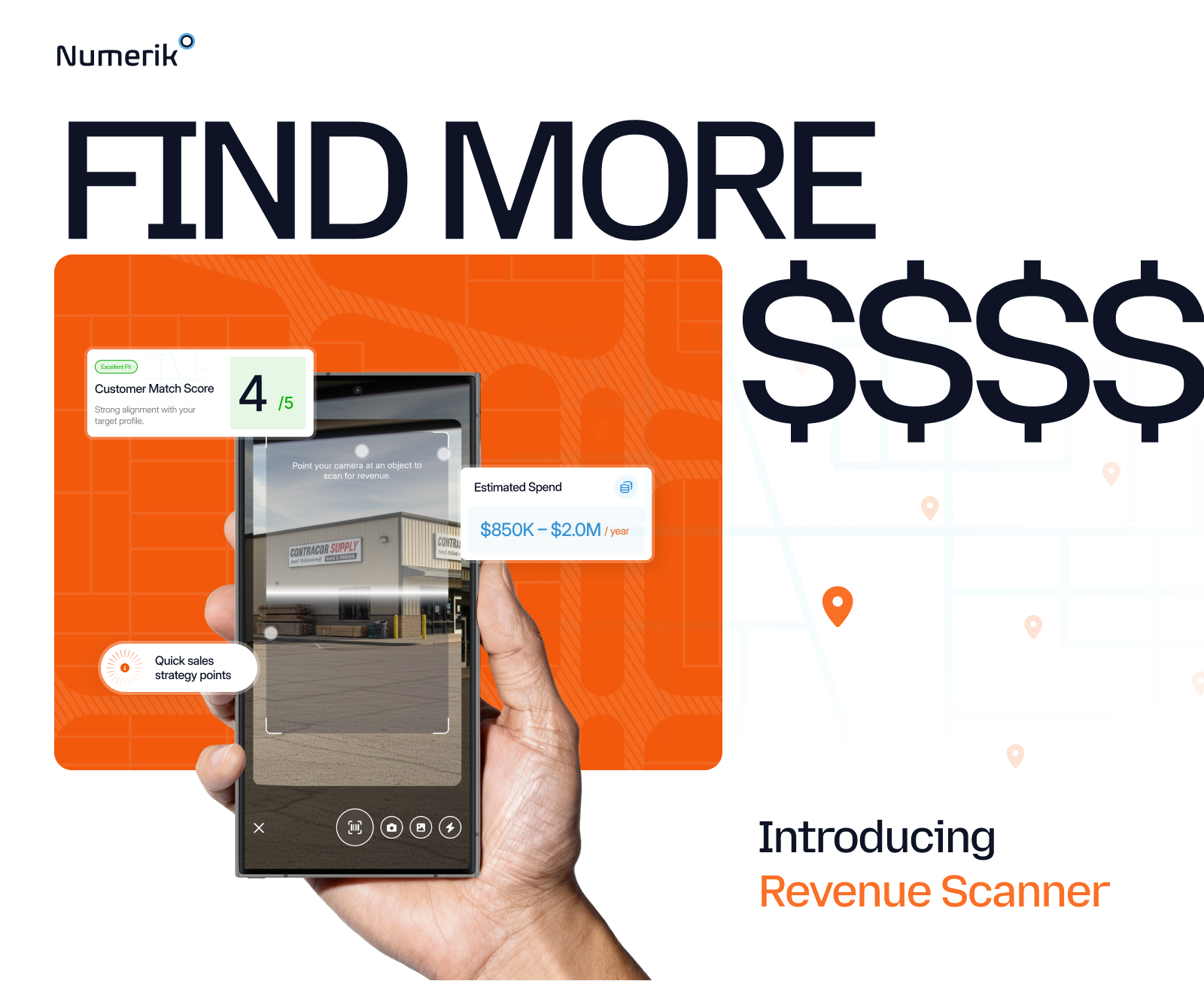
Revenue Scanner is a fast, mobile tool that helps reps identify new customers around them, understand who they are, and decide whether to act, all in seconds. It is simple, immediate, and built to deliver the one thing every rep wants more of: clarity on where to find revenue.
Revenue Scanner is just the beginning. Behind it is a growing ecosystem of AI-powered tools, all designed around one mission: helping field reps discover revenue faster, in less time, and with more confidence than ever before.
We are not here to build another CRM.
We are here to build what comes after it.
Join the Revenue Scanner movement

At Numerik, we emphasize the distinction between real numbers and unreal numbers. Real numbers are the metrics that truly matter to sales reps—the data they need to drive sales. Understanding and focusing on these real numbers can significantly enhance sales performance and keep your team engaged and motivated.
Real numbers are the concrete, actionable metrics that sales reps rely on to understand their performance and strategize their next moves. These include:
Reps also care about market fluctuations, such as a top-performing customer who suddenly drops off the radar or a top-selling product that slows down. These are the real numbers that matter in a rep's mind. They provide a clear, immediate picture of the sales landscape and allow reps to respond proactively.
Unreal numbers include metrics that are more theoretical and less actionable, such as:
Sales reps can’t stake their monthly salary on these numbers. Every rep knows you can make your pipeline look impressive by tweaking a few percentages, but those calculations have very little connection to the reality of the invoices at the end of the month.
When working with your sales team, remember that they relate to real numbers far more than they do to the unreal numbers of sales theory or the latest hot sales process being hyped on LinkedIn. As soon as you swerve away from real numbers into unreal numbers, you risk losing your reps' attention. They might pretend to follow along out of politeness, but they’ll leave the meeting and go right back to doing what they know works.
Real numbers provide tangible insights that reps can use to improve their performance. They help reps understand:
By focusing on real numbers, you’ll have much better conversations with your sales team. You’ll be addressing the metrics that directly impact their success and motivation.
At Numerik, we believe in the power of real numbers to drive sales performance. By sticking to concrete, actionable metrics, you can keep your sales team engaged, motivated, and focused on what really matters. Avoid the distraction of unreal numbers and theoretical metrics, and you’ll see a significant improvement in your team’s performance and overall sales results.
Real numbers are concrete, actionable metrics like invoiced sales, top-selling products, and top-performing customers that directly impact sales performance.
Unreal numbers, such as weighted pipelines and theoretical metrics, don’t provide actionable insights and have little connection to actual sales results, making them less relevant to reps.
Focusing on real numbers helps sales reps understand what’s driving their success, allowing them to make informed decisions and adjustments to maximize sales and earnings.
Sales reps prefer real numbers because they provide clear, immediate insights into their performance and directly impact their monthly earnings and sales strategies.
Numerik provides tools and dashboards that focus on real numbers, offering sales reps the data they need to drive performance and stay engaged with their sales goals.

At Numerik, our purpose is single-minded: we give sales reps the important data they need to drive sales. Unlike many other sales tools, Numerik focuses on simplicity and relevance, avoiding the clutter of unnecessary features that can bog down productivity.
Many sales tools have become burdened with layers of functionality and features that have little relevance to actual sales. These tools are filled with sales theory buzzwords that reps don’t relate to, such as:
These terms represent a lot of busy work that seldom impacts sales performance. Sales reps know what drives the bottom line because it directly affects their paychecks. They care about straightforward metrics like what their customers have spent so far this month and what products they’ve bought. Over-engineered sales tools, with hundreds of functions, often fail to provide the real-time sales data reps actually need.
No salesperson has ever excitedly looked forward to working on "sales enablement." Instead, sales reps want to know practical, actionable information. For instance, a rep might reluctantly spend an afternoon lead scoring because their manager requires it, but they see these activities as largely a waste of time. What reps truly need is immediate access to data that helps them close sales.
Numerik is designed with the sales rep in mind, focusing on the essential data that matters. Here’s how we keep it simple and effective:
At Numerik, we strip away the unnecessary complexities of traditional sales tools to provide sales reps with the essential, real-time data they need. By focusing on simplicity and relevance, Numerik helps sales teams drive performance and achieve better results.
Real-time data allows sales reps to access up-to-date information quickly, making informed decisions and staying on top of their sales targets.
Numerik focuses on simplicity and relevance, avoiding the clutter of unnecessary features and buzzwords, and providing essential data that drives sales performance.
Numerik provides actionable insights and real-time sales data, helping reps make informed decisions and focus on activities that directly impact their sales results.
Over-engineered tools often include features that are not directly related to sales activities, leading to wasted time and decreased productivity.
Numerik offers a user-friendly interface and essential data that helps sales reps stay focused, motivated, and informed, ultimately improving sales performance.

Sales reps need to understand which sales activities drive results and how their results compare to their peers. At Numerik, we provide sales teams with activity visibility using three essential tools: identifying and tracking key activities, forecasting revenue, and tracking incentives on the fly.
Sales reps engage in various activities, from posting on LinkedIn to face-to-face visits. To optimize their efforts, they need to determine which activities yield the best results. A good analogy is trying to lose weight: you need to focus on two key activities—exercise and watching what you eat. Similarly, in sales, reps should identify and consistently perform activities that drive results.
Tracking sales activities against real-time sales results helps reps see the direct connection between their actions and outcomes. This approach prevents overcomplicating sales strategies and allows reps to focus on high-impact activities.
Forecasting where your numbers will come from is crucial for driving sales performance. Viewing future goals as a mountain to climb helps reps visualize their path to success. They need to see the gap between their current sales and their targets, and plan how to bridge it.
Revenue forecasting involves assigning sales numbers to customers and adding them up to see if they meet the overall goal. This process is exciting as it shows how each small contribution brings them closer to their target. Having a clear plan boosts confidence and provides a sense of calm, knowing they are on track to meet their goals.
The final piece of the puzzle is tracking incentives in real-time. Seeing potential earnings based on achieving sales forecasts, and even more if targets are exceeded, significantly drives motivation. Knowing their earning potential keeps reps focused and motivated to push beyond their targets.
Combining sales activity tracking, revenue forecasting, and incentive tracking provides a holistic approach to driving sales performance. It ensures that reps are not only focused on the right activities but also understand the financial rewards of their efforts.
By identifying and tracking key activities, forecasting revenue, and tracking incentives in real-time, Numerik offers a comprehensive solution for enhancing sales performance. These tools empower sales reps with the insights they need to stay motivated and achieve their targets.
Identifying and tracking key sales activities helps reps focus on high-impact actions that drive results, preventing wasted effort on less effective tasks.
Revenue forecasting helps reps visualize their path to achieving sales targets, providing a clear plan and boosting confidence in reaching their goals.
Real-time incentive tracking shows reps their potential earnings, keeping them motivated and focused on exceeding their targets.
Numerik offers tools to identify and track key activities, forecast revenue, and track incentives in real-time, providing a comprehensive view of sales performance.
Numerik's tools ensure that sales reps focus on the right activities, understand their progress, and stay motivated by seeing their potential earnings, leading to improved performance.

Real-time data is essential to drive sales. That’s why we’ve built a sales tool that makes it ultra-quick and easy for reps to check revenue and customer data on the road, any time of day or night. Our approach to instant data has three essential ingredients: customer dashboards, powerful search, and customer notes.
Customer dashboards are a cornerstone of our instant data strategy. When reps are about to visit a customer, they can open that customer’s dashboard with just a click. Within seconds, they can see key metrics and, if needed, dive deeper into sales in specific product categories. This capability allows reps to answer important questions such as:
Reps can also review notes from their last meeting to ensure they’re up-to-date. The customer dashboard view allows reps to share data with customers, demonstrating professionalism and preparedness.
Powerful search is a key part of instant data. Reps using Numerik can hop on the app throughout their day to search for customer contact details, last month’s sales data, or an invoice for their next sales call. Accurate search functionality provides instant access to any data they need, making their job easier and more efficient.
Incomplete, outdated, or inaccurate customer notes are a major pain point for many sales teams. It’s one of the top problems sales teams mention when they move to Numerik. This issue often arises because many CRMs make it clunky and awkward to take notes.
Numerik’s notes function is designed to make customer notes quick and easy. Reps can come out of a call, photograph their notes, post them to the sales feed with a voice note, and assign a task in minutes. The social-style sales feed encourages this behavior by rewarding reps with support from the rest of the team, who jump in to cheer each other on.
Instant data is essential to drive sales, and Numerik delivers it in three powerful ways: customer dashboards, powerful search, and easy-to-use customer notes. By providing real-time access to critical information, Numerik helps sales reps stay informed, prepared, and motivated, ultimately driving better sales performance.
Real-time data allows sales reps to access up-to-date information quickly, making informed decisions and staying on top of their sales targets.
Customer dashboards provide key metrics and detailed insights into a customer's purchasing history, helping reps prepare for meetings and demonstrate professionalism.
Numerik's search feature provides accurate, instant access to any needed data, such as customer contact details, sales data, and invoices, enhancing efficiency.
Numerik's notes function is quick and easy, allowing reps to photograph, post, and assign tasks related to customer notes in minutes, ensuring accurate and up-to-date records.
The social-style sales feed encourages reps to share updates and notes, providing support and positive reinforcement from the rest of the team, fostering a collaborative environment.

Goal tracking is a fundamental foundation of sales success. But how do you track goals effectively? Here are three steps we recommend for setting and tracking goals that drive sales performance.
When we talk about setting goals, we get granular. Start by taking your overall sales goal and breaking it down into targets for every rep and then even further into targets for every customer. This detailed approach ensures that each team member knows exactly what they need to achieve, fostering accountability and focus.
Once you have your granular goals, you can build out a sales paceline that tracks where sales need to be for your team to meet its targets. Your paceline should account for seasonal sales fluctuations and phase revenue to align with product promotions or other factors influencing sales.
It’s crucial for your reps to know exactly where they stand compared to where they should be at any point in the month or year. Additionally, set activity goals for your team, such as the number of calls and face-to-face visits they should make each month. Sales activity tracking allows reps and sales managers to quickly see if the team is on track for those key activities that drive sales.
Once your goals and paceline are in place, real-time data allows you to unpack your goals further and understand why your sales results are the way they are. A rep can check their progress with a key customer and, if they’re behind target, dig deeper into product categories to identify which areas are lacking.
For instance, if a rep notices they’re not meeting their target with a key customer, they can investigate which products are underperforming and then engage with the client to understand why those products aren’t being purchased anymore. This level of detail provides actionable insights, making real-time data essential for driving sales.
Effective goal tracking involves setting granular targets, building a comprehensive sales paceline, and utilizing real-time data to monitor and adjust performance. By following these three steps, you can ensure that your sales team remains focused, motivated, and equipped with the insights needed to achieve their goals.
Setting granular targets ensures that each team member knows exactly what they need to achieve, fostering accountability and focus.
A sales paceline tracks where sales need to be for your team to meet its targets, accounting for seasonal fluctuations and aligning revenue with product promotions and other factors.
Real-time tracking allows sales reps to unpack their goals, understand sales results, and gain actionable insights to improve performance.
Setting activity goals, such as the number of calls and visits, helps ensure that sales reps are engaging in key activities that drive sales and allows managers to monitor progress.
Numerik is designed in collaboration with field sales reps to focus on activities that consistently boost sales performance, providing real-time data, goal tracking, and activity visibility.

How do you really drive sales performance? At the end of the day, the intent of all sales systems, whether they are CRMs, BI tools, or sales performance apps, is to help you sell more. It's essential that these tools are based on solid sales psychology. At Numerik, we approach sales performance through three critical buckets of activities: goal tracking, instant data, and activity visibility. These align perfectly with the three criteria we discussed in our previous blog.
As we mentioned before, you can’t get anywhere without knowing exactly where you’re going. Goal tracking involves setting very granular targets, including activity goals, gross profit, and revenue targets. With clear, measurable goals, sales reps have a concrete direction and purpose, which is crucial for driving performance. Establishing clear goals, tracking progress, and ensuring you have buy-in from your sales team are vital steps in this process.
Your sales team needs instant access to real-time data. Whether they are out on the road or in the office, reps must be able to see what customers are spending and buying. This real-time access to data helps them stay informed and make quick, informed decisions.
Additionally, reps want to see how they’re tracking with their sales goals and performance bonuses. Knowing their progress keeps them motivated and encourages them to sell more. Numerik provides this real-time data access, ensuring that reps always have the information they need at their fingertips. This aligns with the second criterion we discussed: providing reps with instant access to the data they need.
It’s important for sales reps to be able to track their sales activities. This visibility helps them close the loop by allowing them to look at their score sheet and ask, “Okay, well, this is what I did this month. Are these activities actually having an effect on sales?” If an activity isn’t effective, it’s not worth the effort.
Sales reps aren’t looking for admin tasks to fill their day; they want to focus on activities that will help them grow sales. Numerik provides the tools to track these activities, ensuring that reps can focus on what truly drives sales performance. This criterion matches our third point: making sales activity visible to measure effectiveness and drive performance.
These three pillars of sales activity—goal tracking, instant data, and activity visibility—are based on what we know drives sales results. We've built Numerik in collaboration with field sales reps to focus on the activities that consistently boost sales performance. We understand that you don’t want to waste time on activities that don’t grow sales.
Driving sales performance involves focusing on goal tracking, instant data access, and activity visibility. Numerik supports these pillars by providing tools that ensure your sales team can set and track goals, access real-time data, and monitor their activities effectively. This comprehensive approach helps boost sales performance and ensures that your team focuses on what truly matters.
Goal tracking involves setting specific, measurable targets for sales reps, including activity goals, gross profit, and revenue targets. It provides direction and purpose, which are crucial for driving performance.
Instant data allows sales reps to access real-time information on customer spending and buying habits. This helps them make informed decisions quickly and stay motivated by tracking their progress toward sales goals and bonuses.
Activity visibility helps sales reps track their sales activities and assess their effectiveness. This ensures they focus on activities that drive sales performance rather than unproductive tasks.
Numerik was built in collaboration with field sales reps to focus on the activities that consistently boost sales performance. By ensuring goal tracking, instant data access, and activity visibility, Numerik helps drive sales results effectively.

Three key criteria drive sales performance: tracking granular goals, providing reps with real-time data on sales, and making sales activity visible. Here's how Numerik supports each of these critical areas to enhance your sales team's performance.
Establishing and tracking clear goals is essential for any sales team. For a salesperson, these goals could include:
To ensure these goals are effective, you must have buy-in from your sales team. There’s no point in establishing goals that reps don’t rate as important. With Numerik, you can set these granular goals, track progress, and keep your team engaged with targets that matter to them.
Once you're tracking your goals, the next step is giving your sales team instant access to the data they need. This includes:
Numerik offers a powerful search feature, allowing reps to find any data they need quickly. Instant access to this information helps reps make informed decisions and stay on top of their sales targets. Additionally, the platform allows reps to see at a glance whether they’re on track for their targets, providing immediate feedback and motivation.
To complete the loop, it’s crucial to record your sales teams’ activities. By doing this, you can start to see what activities are working. For example, if your reps are engaging in certain sales activities, you can track whether these activities are having a positive impact on your sales results.
Numerik supports this by making it easier for you to:
By having visibility into these areas, you can identify which strategies are effective and which ones need adjustment, ultimately driving better sales performance.
Numerik is designed to enhance your sales team's performance by focusing on three key criteria: tracking granular goals, providing real-time data, and making sales activity visible. By leveraging these features, you can ensure your sales team stays motivated, informed, and productive, leading to improved sales results.
Granular goals are specific, measurable objectives that sales reps aim to achieve, such as revenue targets, sales of high-GP products, and the number of face-to-face visits.
Real-time data provides sales reps with up-to-date information on customer spending, product orders, and market trends, allowing them to make informed decisions and stay on track with their targets.
Visibility into sales activities helps identify which strategies are effective and which ones need adjustment, ensuring that sales reps are engaging in activities that positively impact sales results.
Numerik allows you to set, track, and monitor progress toward granular goals, ensuring that sales reps remain focused and engaged with their targets.
Yes, Numerik enhances performance by providing tools to track goals, access real-time data, and gain visibility into sales activities, leading to better decision-making and improved sales outcomes.

I just hopped off a call with a Numerik customer who shared how impactful it has been for his reps to see what they're earning in real time. He said it’s made a significant difference for their business.
This business has set up their Numerik sales reports so reps can see exactly when their incentives kick in. Reps must hit a certain threshold, aiming for 10% growth over last year, to start earning their bonus rate. This visibility has been huge from an engagement perspective, with reps constantly checking their sales reports to see where they stand and what they could potentially earn.
The sales manager highlighted that Numerik has dramatically increased engagement. Reps are motivated by seeing their potential earnings, which drives them to perform better. One particularly enthusiastic rep even filled out his sales target cards for the rest of the year using Numerik’s forecasting feature. By looking at past sales figures and projecting future sales, he could visualize his potential earnings.
Often, sales teams forecast together, but this rep was so engaged that he did his forecast himself, totally unprompted. Making your reps’ earnings visible is a critical part of driving sales performance. With Numerik, they can see their earnings stacking up in real-time and easily visualize how much more they could earn by increasing their sales.
Forecasting becomes a game with Numerik. Reps start to play with the numbers, thinking:
Numerik stands out from traditional sales platforms by focusing on what motivates sales reps. It's all about the money. When a rep asks, "What's in it for me?" they’re really asking, "What can I earn?"
Numerik’s real-time earnings visibility and forecasting features drive higher engagement and sales performance by clearly showing reps their potential earnings. This approach not only motivates reps but also makes the sales process more engaging and fun.
Real-time earnings visibility motivates sales reps by showing them exactly how much they are earning and what they could potentially earn, driving higher engagement and performance.
Numerik’s forecasting feature allows reps to project their future sales and potential earnings, making the process engaging and motivating.
Numerik focuses on what motivates sales reps, primarily their earnings, making it more effective at driving performance compared to traditional sales platforms.
By providing real-time visibility into earnings and clear incentives, Numerik increases reps' engagement and motivation, leading to higher sales performance.
Numerik makes forecasting and earnings projections a fun and engaging activity, encouraging reps to set and achieve higher sales targets.

Most Numerik customers come as a result of referrals from enthusiastic sales managers whose teams use Numerik and are growing their sales. We often receive emails from sales leaders sharing their positive experiences. They usually start with a story about how a colleague recommended Numerik to solve their sales challenges.
Despite the different problems sales managers mention, we see the same issues over and over again. Here are the top three problems Numerik solves:
Important data that sales reps need for sales calls is often hard to find. It takes too long to run reports, and even when you do, the data is outdated.
Numerik provides instant access to real-time sales data on the road. The customer dashboards offer an at-a-glance overview, and reps can drill down to find the info they need in seconds. This answers important questions like:
Reps often avoid taking notes after calls and customer visits because the CRM system is too clunky. When forced to update records, they may fabricate details because they can't remember specifics, making the notes unreliable.
Numerik’s social media-style sales feed means notes take seconds to post. This habit is encouraged by the positive feedback reps receive from the rest of the sales team, ensuring accurate and useful customer records.
Reps dislike forecasting and often do it inaccurately, leading senior leaders to distrust the sales forecasts.
Numerik forecasting is based on real-time sales data. By analyzing what a customer has spent over the last few months or years and looking at their current deals in the system, reps can make accurate estimates of future spending. This process is quick and easy, adding a sense of calm and ensuring that sales reps feel like they have a solid plan.
Numerik addresses the top challenges faced by sales teams, making it easier to find customer information, maintain accurate records, and forecast sales. These solutions not only improve efficiency but also build confidence in the sales process, leading to better performance and results.
Numerik provides real-time sales data and customer dashboards that offer an at-a-glance overview, allowing reps to quickly find important information needed for sales calls.
Numerik’s social media-style sales feed encourages reps to quickly post accurate notes after calls and visits, improving the quality and usefulness of customer records.
Numerik uses real-time sales data to create accurate forecasts based on past customer spending and current deals, making the process quick and reliable.
Numerik is user-friendly and designed to provide real-time data, easy note-taking, and accurate forecasting, addressing the common pain points of traditional CRM systems.
If you’d like to see a demo of Numerik and how it can address your sales challenges, drop us a message.

Sales reps are buzzing about the power of sharing Numerik’s new customer dashboard in sales meetings. They love how it helps them present themselves as professional category consultants, and, of course, it grows sales. Now, after the successful response we received about the mobile version, the customer dashboard is available for desktop!
The customer dashboard not only reminds customers what they’ve bought in the past but also shows their customer group ranking. This feature helps customers realize if they’re not stocking certain popular products, which can drive sales.
Numerik is designed to help wholesale distribution sales teams hit their targets. Sales reps using Numerik serve many customers who are part of retail chains, especially in the automotive, construction, and FMCG sectors.
If a customer is part of a chain of stores, there’s a natural sense of healthy competition between the stores. Store owners often compare their sales to other stores in their network. The customer group ranking view in Numerik helps drive that competitive streak. A sales rep might say to a store manager, “Some of the other stores in your chain are going through heaps of these products. But I see you’re not stocking them. Do you want to give them a go?”
This is a brilliant tactic for reps trying to grow the range a customer stocks. Showing a store their customer group ranking heightens that sense of competition and gives them a push to try something new. You can also adapt this tactic to create a sense of competition between competing chains in the same market sector.
While competitors’ sales data is too commercially sensitive to share, Numerik shows total spend on product categories. You can rank that to show top-selling product categories and drill down to see whether your customer is actually buying that range. Then you can say to your customer, “Here are some top sellers in your market sector that you’re not stocking. These products are absolutely flying out the door. How about giving them a trial?”
The new Numerik customer dashboard is proving to be a real winner for making reps feel polished and professional while boosting the range of products a customer stocks. If you’d like to see a demo, drop me a DM.
The new Numerik customer dashboard is a tool designed for sales reps to enhance their interactions with customers by providing insights into past purchases, customer group rankings, and top-selling product categories.
The dashboard helps reps present themselves as professional consultants, reminding customers of their past purchases and showing popular products they may not be stocking, driving increased sales.
Numerik is particularly beneficial for sales reps serving retail chains in the automotive, construction, and FMCG sectors.
The customer group ranking feature shows how a customer’s sales compare to other stores in their chain, driving healthy competition and encouraging them to stock popular products.
Yes, while direct competitors’ sales data is sensitive, Numerik can show total spend on product categories, helping create a sense of competition and encouraging customers to stock top-selling products in their market sector.

The Numerik Index is a quarterly sales ranking where we track each rep’s results and compare them year-on-year. This innovative tool also shows sales reps how they compare to others in their company and to all Numerik users, providing a comprehensive view of their performance on a wider scale.
These reports are released quarterly and will be sent out throughout the month. Please keep an eye out for your report coming by month's end!

The Numerik Index was inspired by school reports. In Australia, students receive a mark for subjects like math, and their report also shows how their mark compares to other students in their school, state, and nationwide. Similarly, the Numerik Index acts as a brilliant scorecard for sales reps and managers.
Sales managers receive a report that includes all their reps, offering a clear overview of individual and team performance. This report helps managers identify top performers, areas for improvement, and overall sales trends.
The Numerik Index answers a common question: what’s happening in the market? Is it busy or quiet? If your team is struggling, are others in the same boat? As the number of Numerik users rises steadily, we hope to start doing industry sale rankings for businesses in automotive, construction, and FMCG sectors. This will allow you to benchmark your performance against others in your industry, providing valuable insights into market trends and competitive positioning.
The Numerik Index is more than just a ranking; it’s a powerful tool for understanding your sales performance in context. By comparing results year-on-year and against peers within the company and across all Numerik users, sales reps and managers gain valuable insights to drive improvement and stay competitive.
The Numerik Index is a quarterly sales ranking that tracks each rep’s results year-on-year and compares their performance within their company and across all Numerik users.
Like school reports that show how students compare to their peers, the Numerik Index provides a scorecard showing how sales reps rank compared to others in their company and across all Numerik users.
Sales managers receive a comprehensive report that includes all their reps, helping them identify top performers, areas for improvement, and overall sales trends.
The Index helps answer questions about market activity by comparing your performance to others. As more users join Numerik, industry-specific rankings will offer deeper benchmarking insights.
We aim to provide industry sale rankings for businesses in automotive, construction, and FMCG sectors, allowing for more precise benchmarking and performance insights.

In our previous discussion, we highlighted the importance of involving your sales team in the selection process of new sales tools. As a follow-up, let's dive into how we at Numerik ensure a smooth and effective rollout by designing a customized sales playbook for your team.
When we roll out Numerik with your team, we collaborate to design a sales playbook that outlines how your reps can use the app every day. This playbook focuses on three main ways your team will use the app and trains them to use it confidently in each scenario.
We begin with simple, relatable tasks that add value to your sales process. This might include accessing the customer dashboard before a sales visit or posting updates to Numerik’s social-media style live feed after a meeting. These initial steps help your team see immediate benefits and build confidence in using the app.
Your sales playbook will detail how your team can use Numerik to prepare for sales visits. We guide your reps through these processes to ensure they are familiar and comfortable with the tools available to them. This preparation can significantly enhance the effectiveness of their sales interactions.
We work together to decide on the three primary use cases for your playbook by mapping your current sales processes and identifying the areas where Numerik will drive the most performance improvement. This targeted approach ensures that your team focuses on the most impactful aspects of the tool.
Before adopting this focused training approach, we would ask new Numerik customers how they wanted their system set up. Often, customers hadn't fully considered their sales improvement priorities, leading to uncertainty and a reliance on general best practices. Now, we offer a hyper-focused onboarding experience that clarifies your areas for improvement and ensures your team understands how to use Numerik effectively in those key areas.
By designing a tailored sales playbook and focusing on three main use cases, we ensure that your team can confidently and effectively use Numerik. This targeted approach leads to better adoption rates and significant improvements in sales performance.
A sales playbook is a document that outlines best practices, processes, and strategies for using sales tools and executing sales tasks effectively.
Focusing on three main use cases ensures that your team can master the most impactful aspects of the tool, leading to better adoption and performance.
Numerik provides tools like the customer dashboard and live feed updates, which help sales reps prepare thoroughly and stay informed during sales visits.
A hyper-focused onboarding experience provides clarity on areas for improvement and ensures that your team understands how to use Numerik effectively, leading to higher adoption rates and improved performance.
By streamlining sales processes, providing valuable insights, and facilitating better preparation and follow-up, Numerik helps sales teams work more efficiently and effectively.

We recently got off a call with a new Numerik customer, whose IT team leader shared some valuable insights on rolling out sales tools. Despite having implemented many CRMs over the years, he noted that he had never seen a sales team so excited about the rollout of a new sales tool.
In his experience, success isn't necessarily about choosing the tool with the most features. It doesn’t matter how many amazing features a sales tool has; if it hasn't got buy-in from the sales team, encouraging them to adopt and use it will be challenging from the start. His advice was simple yet powerful: go with the sales tool your sales team is most excited about.
To get a sales team on board, involve them in the process of choosing their new sales tool. Often, sales managers decide what sales tools to invest in, but it’s the reps who will be using these tools daily. By involving them in the decision-making process, you ensure smoother adoption and greater enthusiasm.
Engage your sales team early in the tool selection process and relate your fact-finding questions to their day-to-day routines. Here are some questions to consider:
If your team feels that their wish list is part of the criteria used to choose the tool, they're more likely to feel excited about using it. This excitement can vastly improve your chances of a successful rollout.
The IT team leader we’re working with emphasized that having a tool the sales team is excited about is the biggest battle. This enthusiasm can lead to a smoother rollout than any CRM implementation he’s seen before. When sales reps are excited about a new tool, they’re more likely to engage with it, leading to higher adoption rates and better overall performance.
Involving your sales team in the selection process and choosing a tool they’re excited about can significantly impact the success of your sales tool rollout. By asking the right questions and considering the day-to-day needs of your reps, you can ensure that the tool you choose not only meets their needs but also excites them. This approach leads to higher adoption rates, smoother rollouts, and ultimately, a more effective sales team.
Sales team buy-in is crucial because if the team is excited about the tool, they are more likely to use it effectively, leading to higher adoption rates and better performance.
Involving the sales team in the selection process ensures the tool meets their needs and preferences, making them more likely to embrace and use it.
Ask questions related to their daily routines, such as what information they need before and after customer visits, and what reporting they currently lack.
Choosing a tool the sales team is excited about leads to smoother rollouts, higher adoption rates, and better overall sales performance.
Numerik provides a user-friendly platform that sales teams can get excited about, ensuring higher adoption rates and more effective use of the tool.

There's a huge buzz about AI and how it can automate aspects of the sales process to save salespeople time and make them more effective. Have you ever thought about the impact AI could have on the daily life of a salesperson? At Numerik, we're giving it some serious thought.
We've been mapping out all a sales rep's daily activities and all the thoughts that go through their mind. As we’re mapping, we're asking ourselves how Numerik can help maximize sales reps' chances of making sales each day. We're looking at how Numerik can optimize each part of a sales rep's workflow and working on layering AI into the mix to help even more.
Imagine a sales rep planning a trip to Auckland with six hours on the ground. Who should they see to maximize their revenue? AI can draw on data from sales trends to traffic reports. It can help with route planning, prioritize the customers to visit, and suggest sales strategies based on customer sales and notes.
AI is opening up a whole new paradigm for Numerik, turning it into a true sales virtual assistant (VA). This innovation means AI can support sales reps by optimizing their daily schedules, providing data-driven insights, and helping them make informed decisions quickly and efficiently.
As we continue to develop AI enhancements for Numerik, we are excited about the possibilities. If you have any sales AI enhancements you would like to see, please let us know. We are always looking for ways to improve and support our sales teams.
The integration of AI into Numerik is set to revolutionize the daily workflow of sales reps, making them more efficient and effective. By automating routine tasks and providing intelligent insights, AI can help sales reps focus on what they do best: selling.
AI can automate routine tasks, provide data-driven insights, and help sales reps prioritize their activities to maximize sales and efficiency.
AI can save time, improve decision-making, enhance customer interactions, and increase overall sales performance.
AI can analyze sales trends, customer data, and traffic reports to suggest the best routes and prioritize customer visits for maximum revenue.
A sales VA is an AI-powered tool that assists sales reps by automating tasks, providing insights, and optimizing workflows to improve sales performance.
Numerik is working on layering AI into its platform to optimize sales workflows, provide intelligent insights, and enhance the overall effectiveness of sales reps.
.jpg)
How’s your sales incentive scheme going? One of the biggest challenges we’ve observed is sales reps who don't understand how their incentive plan works. If your reps don't understand their commission scheme, the plan ceases to achieve its intent.
We’ve seen situations where reps get to the end of the quarter, receive an incentive, and say, “Oh, I didn't even realize I’d qualified. Thank you!” If that happens, you know the whole purpose of your incentive scheme has been lost. Incentive plans exist to motivate your sales team. They’re meant to be something reps chase, a bonus that drives higher sales and incentivizes reps to perform—not just a pleasant surprise.
The most effective incentive plans are so simple that a rep can work out their bonus in their head. Keep your incentive scheme simple enough so reps can say, “I know when my sales hit this target, I make 2% of all my sales, and I can calculate that bonus myself.” This simplicity makes an incentive plan more successful.
Sure, you can put lots of gates and conditions on a scheme, but if you do, it soon gets beyond the point where reps can calculate their bonus in their head. As soon as you introduce complexity, incentive schemes lose momentum and effectiveness.
Numerik has a tracking solution where a rep can see what they're earning every day in real-time, including incentive schemes. Making those figures visible really boosts motivation. Some Numerik customers who ran incentive schemes before they used Numerik saw increased sales as soon as reps could see their earnings in real time and easily understand what their bonus could be if they sold even more.
Simplifying your sales incentive scheme can greatly enhance its effectiveness. By ensuring that your reps can easily understand and calculate their bonuses, you keep them motivated and focused on achieving their targets. Real-time tracking solutions like Numerik can further boost motivation by providing visibility into daily earnings and potential bonuses.
A sales incentive scheme is a structured plan that rewards sales reps for achieving specific sales targets or goals, usually through bonuses or commissions.
A simple incentive scheme is easy for sales reps to understand and calculate, keeping them motivated and focused on achieving their sales targets.
Complex incentive schemes can confuse sales reps, making it difficult for them to understand and calculate their bonuses, which can lead to decreased motivation and performance.
Real-time tracking allows sales reps to see their earnings and potential bonuses daily, increasing motivation and encouraging them to sell more.
Numerik provides a tracking solution that includes real-time visibility of earnings and incentive schemes, helping sales reps understand and calculate their bonuses, thus boosting motivation and sales performance.
.jpg)
In our previous discussion, we explored the importance of setting relevant and simple sales KPIs. In this follow-up, we'll delve deeper into why keeping your KPIs focused and straightforward is crucial, with a compelling example from Airbnb's early days.
Someone once shared a story about how Airbnb, in its early days, maintained a sharp focus on a single sales KPI. They created a graph of their sales target and posted it everywhere. Team members would even draw the graph on sticky notes and stick them on their computers.
If sales were above the line, it was a sign of success. If sales dipped below the line, the entire focus shifted to figuring out how to get back above the line. This straightforward approach kept everyone aligned and motivated.
Sales managers often overcomplicate KPIs because they are inundated with requests for information from various departments. Senior leadership wants to know certain metrics, marketing demands other data, and fulfillment has its own set of requirements. While all these requests are valid, not all the data points should be considered sales KPIs.
Despite being a digital start-up with access to vast amounts of data, Airbnb chose not to track hundreds of KPIs. They kept their sales KPI simple and easy to understand. This focus helped them maintain clarity and drive success.
By concentrating on a single KPI, Airbnb ensured that their sales team knew exactly what was expected of them. This clarity allowed the team to excel in their roles without being overwhelmed by multiple metrics.
Your sales team cannot track ten different metrics and excel at all of them. It's essential to keep your KPIs simple to ensure that your team can focus on what truly matters.
While it's important to surface data for various departments, not all data points need to be tracked as KPIs by your sales team. Prioritize the metrics that directly impact sales performance and keep the focus sharp.
The example of Airbnb, a company worth $93.34B as of May 2024, illustrates the power of maintaining a single-minded focus on sales KPIs. By keeping your KPIs simple and relevant, you can drive your sales team to achieve outstanding results. Remember, simplicity and clarity are key to effective KPI management.
Having a single KPI helps maintain focus and clarity within the sales team, ensuring everyone is aligned and working towards the same goal.
Identify the KPI that directly impacts your sales objectives and drives the desired behavior in your sales team. This KPI should be easy to understand and track.
Yes, tracking too many KPIs can overwhelm your sales team and dilute their focus, leading to decreased performance.
Regularly review your KPIs, ideally on a quarterly basis, to ensure they remain relevant and effective in driving sales performance.
CRM systems, analytics tools, and dashboards can help manage and track sales KPIs effectively, providing real-time data and insights.
.jpg)
Tracking the right sales KPIs is crucial for the success of your sales team. However, many sales managers make the common mistake of setting KPIs that their teams find meaningless. This can lead to a lack of engagement and motivation among salespeople. In this article, we'll explore why relevance and simplicity are essential when setting KPIs and how to ensure your KPIs are meaningful to your sales team.
KPIs, or key performance indicators, are metrics used to evaluate the success of an organization or individual in achieving specific objectives. In sales, KPIs help track performance, identify areas for improvement, and align activities with business goals.
For KPIs to be effective, they must align with the overall sales objectives of your organization. This ensures that the metrics you're tracking directly contribute to achieving your business goals.
It's crucial that your sales team understands why each KPI is being tracked. When sales reps comprehend the purpose behind a KPI, they're more likely to relate to it and let it influence their behavior positively.
One common mistake is creating overly complex KPIs. Metrics that involve intricate calculations or multiple variables can confuse your sales team and make it difficult for them to understand how their actions impact these metrics.
When setting KPIs, it's important to involve your sales team in the process. Ignoring their input can result in KPIs that are out of touch with their day-to-day activities and challenges.
Another mistake is focusing on the quantity of KPIs rather than their quality. Having too many KPIs can overwhelm your sales team and dilute their focus. Instead, concentrate on a few high-impact KPIs that truly matter.
Relevant KPIs can enhance your sales team's motivation by giving them clear targets to aim for. When KPIs are meaningful, they provide a sense of purpose and direction.
KPIs should drive the behaviors you want to see in your sales team. For example, if you want your team to focus on customer retention, set a KPI related to repeat business or customer satisfaction.
Effective KPIs can also serve as a tool for personal and professional growth. They help sales reps identify their strengths and areas for improvement, leading to continuous development.
To determine if a KPI is relevant, ask yourself: Why should my sales team care about this KPI? How does it relate to their day-to-day activities? If you can't come up with a compelling reason, the KPI may not be worth tracking.
Evaluate how a KPI impacts your sales team's daily activities. If it's not influencing their behavior or contributing to achieving sales objectives, reconsider its relevance.
Maintain a continuous feedback loop with your sales team regarding KPIs. Regularly review and adjust KPIs based on their input and performance data.
Simple KPIs are easier for your sales team to understand and track. They should be able to calculate these metrics on their own without needing complex formulas or tools. This simplicity ensures that KPIs are clear and actionable.
There are various tools and techniques available to help simplify KPIs. Using dashboards and visualization tools can make KPI data more accessible and understandable for your sales team.
KPIs that include weighted averages, multiple variables, or complex ratios can be counterproductive. For example, a KPI that measures sales performance using a formula that factors in dozens of variables might be too difficult for your team to interpret.
Complex KPIs can lead to confusion and frustration among your sales team. If they don't understand how their actions influence these metrics, they're less likely to be motivated to achieve them.
To simplify complex KPIs, break them down into more manageable components. Focus on the core metrics that directly impact performance and are easily understood by your team.
Identify the key performance areas that are crucial for your sales team's success. These might include lead generation, conversion rates, or customer retention.
Customize your KPIs to fit the unique dynamics of your sales team. Consider factors such as team size, market conditions, and sales cycle length when setting KPIs.
Strike a balance between short-term and long-term goals when setting KPIs. Short-term KPIs can drive immediate results, while long-term KPIs focus on sustained growth and development.
Follow best practices for KPI implementation to ensure success. This includes clearly defining KPIs, setting realistic targets, and providing the necessary resources and support to achieve them.
Regularly review and adjust your KPIs based on performance data and feedback from your sales team. This ensures that your KPIs remain relevant and effective.
Leverage technology to track KPIs efficiently. CRM systems, analytics tools, and dashboards can provide real-time data and insights, helping you monitor progress and make informed decisions.
Use both quantitative and qualitative measures to evaluate the effectiveness of your KPIs. Quantitative data provides hard metrics, while qualitative feedback from your sales team offers valuable insights.
Gather feedback from your sales team to assess the impact of KPIs. Their input can help you identify any issues or areas for improvement.
Analyze performance data regularly to determine the effectiveness of your KPIs. Adjust your KPIs as needed to ensure they continue to drive the desired outcomes.
The key lessons from these case studies highlight the importance of simplicity, relevance, and alignment in setting effective KPIs.
Tracking meaningful KPIs is essential for the success of your sales team. Ensure that your KPIs are relevant, simple, and aligned with your sales objectives.
When setting KPIs, always keep relevance and simplicity in mind. Meaningful KPIs drive the right behaviors and motivate your sales team to achieve their goals.
Continuously review and refine your KPIs to ensure they remain effective. Engage your sales team in the process to foster a sense of ownership and commitment.
A: KPI, or key performance indicator, is a metric used to measure the effectiveness and success of sales activities in achieving specific objectives.
A: KPI is relevant if it aligns with your sales objectives, is understood by your sales team, and drives the desired behaviors and outcomes.
A: Yes, having too many KPIs can overwhelm your sales team and dilute their focus. It's better to concentrate on a few high-impact KPIs that truly matter.
A: KPIs should be reviewed regularly, ideally on a quarterly basis, to ensure they remain relevant and effective.
A: CRM systems, analytics tools, and dashboards are effective tools for tracking KPIs. These tools provide real-time data and insights, helping you monitor progress and make informed decisions.

Tracking sales of hero products effectively is crucial for businesses aiming to maximize their gross profit (GP) and leverage their product strategy. Hero products are those that deliver the best GP, have significant investments, are under promotion, or are prioritized in your product strategy. To ensure your sales team focuses on these products, it's essential to make sales performance visible and trackable. Here's a comprehensive guide on how to track the sales of your hero products:
Tracking the sales of hero products is vital for ensuring your sales strategy is effective and your sales team is focused. Using tools like Numerik, you can set up real-time tracking, sales incentives, and comprehensive scorecards to make sales data visible and actionable. This approach not only helps in achieving your sales targets but also empowers your sales reps by providing clear performance metrics.

Shifting to online orders can inadvertently demotivate your sales team. Many wholesalers are encouraging customers to place orders online, but this transition needs careful management to ensure sales targets are met and sales teams remain motivated.
In recent years, there's been a significant shift in how orders are placed within the wholesale distribution sector. Take, for example, an automotive parts wholesaler who, six years ago, processed 20% of their orders online and 80% via phone. Today, those figures have flipped, with 80% of orders coming through online channels. This shift has been actively driven by wholesalers who aim to streamline their ordering processes.
The move towards online orders is driven by two primary factors:
Given these benefits, it's no surprise that online sales are becoming a focal point for many distributors. However, this brings us to a crucial question: how visible are these online sales to your sales reps?
For your sales strategy to be effective, your reps must have clear visibility into online sales. This transparency is essential for several reasons:
To ensure your sales team can drive more online orders, they need access to detailed information about online sales before making sales calls. This access allows them to have informed conversations with customers, ultimately driving more online orders.
Transitioning to online orders offers significant benefits, but it's vital to maintain your sales team's motivation by ensuring they have the tools and information needed to track and manage these sales effectively. By doing so, you can achieve a balanced approach that leverages the advantages of online ordering while keeping your sales team engaged and productive.
Q: How can shifting to online orders demotivate my sales team?
A: Shifting to online orders can demotivate your sales team if they lack visibility into those sales. Without access to online order data, they might feel disconnected from the sales process and unsure of their impact on company goals.
Q: Why is visibility into online sales important for sales reps?
A: Visibility into online sales is crucial for sales reps to track performance, identify trends, and tailor their strategies. This information helps them engage with customers more effectively and drive more online orders.
Q: How can I ensure my sales reps have access to online sales data?
A: Ensure your sales reps have access to real-time online sales data through a centralized system or sales dashboard. This access allows them to prepare for sales calls and have informed conversations with customers.
Q: What are the benefits of encouraging customers to place orders online?
A: Encouraging online orders can reduce operational costs, provide convenience for customers, and offer opportunities for showcasing other products and upselling. It streamlines the ordering process and can lead to increased sales.
Q: How can I balance the shift to online orders while keeping my sales team motivated?
A: To balance the shift, provide your sales team with the tools and information they need to track and manage online sales. Ensure they understand the importance of their role in driving online orders and recognize their contributions to the company's success.

Your sales reps are the frontline soldiers, out there making connections, nurturing relationships, and closing deals. However, there's a common issue that can hamper their productivity and morale: access to relevant, actionable data. Weighted pipelines and stage three deals with a 32% chance of closing might be valuable for strategic planning, but they don't always help your reps in their daily grind.
Sales reps are most effective when they have simple, essential information at their fingertips, such as:
This straightforward data is crucial because it enables your sales reps to engage in meaningful conversations with customers, tailor their pitches based on purchase history, and ultimately close more deals. Unfortunately, this critical information can sometimes get buried in complex customer relationship management (CRM) systems.
CRMs are designed to manage customer interactions and data, but they often become overly complicated with functionalities that aren't always useful to sales reps on the road. When theoretical sales processes take precedence over practical data retrieval, the result can be a tool that hinders rather than helps.
From our perspective, a great sales tool should strip away the fluff and focus on the key information that genuinely supports a rep’s daily activities. This philosophy has been the driving force behind every improvement we've made to Numerik. By continuously asking ourselves what data truly matters to your reps, we've been able to create a more effective and user-friendly tool.
As more wholesalers encourage customers to place orders online, there's a new dynamic at play. This shift, often motivated by cost savings and customer convenience, has seen a dramatic increase in online orders. Take, for example, an automotive parts wholesaler who shifted from 20% online orders and 80% phone orders six years ago, to the exact opposite ratio today.
However, a crucial question arises: how visible are these web sales to your sales reps? If your reps are driving customers to order online, they need to be able to track these sales just as easily as their direct orders.
Without this visibility, there’s a risk of demotivating your sales team. If the results of their efforts to drive online sales are invisible to them, their morale could take a hit.
Recognizing these challenges, we're integrating features into Numerik to track web sales as a percentage of all sales. This addition aims to give your reps the visibility they need to feel connected to the outcomes of their efforts, whether the orders are placed online or directly through them.
We're excited about the enhancements we're making to Numerik, and we'd love to share our progress with you. If you're interested in learning more about how we're evolving to support your sales teams better, drop us a message. Together, we can ensure that your reps have the tools they need to succeed in today’s digital sales environment.
In conclusion, the success of your sales reps hinges on having access to the right information at the right time. By focusing on essential data and ensuring that online sales are visible and trackable, you can empower your team to drive more sales and maintain their motivation. At Numerik, we're committed to providing the tools that make this possible, simplifying complex processes and keeping your reps equipped with what they need to excel.
Q: What is the most important type of information for sales reps to access?
A: Current sales figures, last invoice details, customer purchase history, and recent order dates are crucial for meaningful customer interactions.
Q: Why do CRMs often fail to help sales reps?
A: CRMs can become too complex, with functionalities that do not directly support the day-to-day needs of sales reps, making it difficult to retrieve essential information quickly.
Q: How can online sales visibility affect sales reps' motivation?
A: If sales reps can't easily track the results of their efforts to drive online sales, it can lead to demotivation as they feel disconnected from the outcomes of their work.
Q: What changes are being made to Numerik to support sales teams better?
A: Numerik is integrating features to track web sales as a percentage of all sales, providing reps with the visibility they need to see the impact of their efforts.
Q: How can businesses ensure their sales tools are effective for reps on the road?
A: By focusing on simplifying tools to highlight essential data and removing unnecessary functionalities, businesses can create more user-friendly and effective sales tools.

Leading a sales team comes with immense pressure to consistently meet targets and drive revenue growth. During my tenure as a sales leader, I found myself under this very pressure, constantly seeking ways to uncover hidden opportunities and boost sales performance. Two fundamental questions became my go-to strategy for finding those extra dollars that made all the difference.
These questions might seem basic, but they proved to be incredibly effective in identifying gaps and opportunities within my client base.
To start, I’d grab my pen and paper and make a list of my clients who weren’t performing at the top end. This list was my starting point for a deeper investigation into their buying patterns.
Next, I would examine which product groups each client was heavily invested in. Typically, I’d find a couple of product groups that the client consistently purchased. This was a good sign of their current interests and needs.
Then, I’d look at the product groups they rarely or never bought from. These gaps represented potential areas for growth. Identifying these underutilized product ranges opened up opportunities to expand the client's purchasing behavior.
Once I had a clear picture of the client’s buying habits, I’d brainstorm ways to both grow their existing interests and introduce them to new product groups. This involved considering various factors, such as whether the client was currently expanding their business or experiencing a particularly busy period.
The next step was to schedule a call or meeting with the client. This direct engagement allowed me to discuss their current needs and introduce the underutilized product ranges.
During these conversations, clients often provided valuable insights. They might say, “We used to buy those, not sure why we stopped,” or “We didn’t even know you had those other product ranges available.” These responses indicated a lack of awareness or a change in their needs, each representing a potential sales opportunity.
By understanding their reasons and addressing any gaps in their knowledge or needs, I could tailor my sales approach to better meet their requirements. This often resulted in renewed interest in previously overlooked product groups and, ultimately, increased sales.
These two questions, simple as they are, consistently helped me uncover hidden opportunities and drive sales growth when I needed it most. By methodically examining client buying patterns and engaging in meaningful conversations, I could turn gaps into revenue-generating opportunities. If you’re feeling the pressure to meet sales targets, start with these questions and watch as new possibilities unfold.
Q: How do these two questions help in uncovering sales opportunities?
A: By identifying what product groups clients are heavily invested in and which they rarely buy from, sales leaders can spot gaps and tailor their approach to introduce underutilized products.
Q: Why is it important to make a list of underperforming clients?
A: Focusing on underperforming clients allows sales leaders to identify potential areas for growth and develop strategies to improve their performance.
Q: How can scheduling calls and meetings with clients help boost sales?
A3: Direct engagement helps uncover client needs, address gaps in their knowledge, and introduce new product ranges, leading to increased sales opportunities.
Q: What are common reasons clients stop buying certain products?
A4: Clients might stop buying due to changes in their needs, lack of awareness about available products, or shifts in their business focus. Identifying these reasons can help tailor the sales approach.
Q: How can sales leaders grow existing client interests?
A: Sales leaders can grow existing interests by understanding client needs, providing relevant product information, and highlighting the benefits of expanding their purchasing to include new product groups.

In the ever-evolving world of sales, staying ahead of the curve is crucial. With the rapid advancements in technology, particularly in Artificial Intelligence (AI), sales professionals have a golden opportunity to enhance their productivity and efficiency. Have you invested time in mastering AI tools? If not, now is the perfect time to start. Here’s how AI is transforming the sales landscape and how you can leverage it to your advantage.
AI is revolutionizing the sales industry, offering innovative solutions that streamline tasks and boost productivity. From automating routine tasks to providing deep insights into customer behavior, AI tools are becoming indispensable for sales professionals.
One of the standout AI tools making waves in the sales sector is Chat GPT 4.0. This powerful AI has several functionalities tailored for salespeople, making it a game-changer in managing day-to-day activities.
Imagine being able to save hours of work each week by simply taking a photo of your notebook and having Chat GPT transcribe your meeting notes. This feature alone can significantly reduce the time spent on administrative tasks, allowing you to focus more on closing deals.
Staying ahead of the competition requires staying informed. Chat GPT can help you quickly summarize competitor advantages, giving you a strategic edge in your sales pitches.
Discovery questions are crucial for understanding your client's needs. Chat GPT can assist in generating insightful questions that can uncover critical information, helping you tailor your sales approach effectively.
Crafting the perfect call script or email can be time-consuming. Chat GPT simplifies this process by drafting compelling scripts and email copies, ensuring your communication is both professional and persuasive.
Apart from Chat GPT, numerous other AI tools can enhance your sales workflow. For instance, AI notetakers can transcribe and summarize all your calls, saving you the hassle of manual note-taking. While not perfect, these tools are incredibly handy and can save you hours each week.
To stay current with the latest tech trends, it's beneficial to follow thought leaders and experts in the AI space on LinkedIn. Here are a few recommendations:
At Numerik.io, we're committed to integrating AI into our platform to revolutionize the sales process. We've been brainstorming on how AI can support sales professionals in becoming more informed and efficient throughout their day. Stay tuned for exciting AI developments later this year that will transform your sales experience.
AI is no longer just a buzzword; it's a powerful tool that can transform the way sales professionals operate. By embracing AI tools like Chat GPT 4.0 and staying updated with the latest advancements, you can streamline your workflow, gain valuable insights, and ultimately close more deals. Keep an eye on Numerik.io for innovative AI solutions that will elevate your sales game to the next level.
Q1: How can AI tools like Chat GPT 4.0 save time for sales professionals?
A1: AI tools can automate routine tasks such as transcribing meeting notes, summarizing competitor information, and drafting call scripts, saving hours each week.
Q2: Are AI notetakers reliable for transcribing calls?
A2: While not perfect, AI notetakers are highly useful and can significantly reduce the time spent on manual note-taking.
Q3: Who are some key influencers to follow for AI updates in sales?
A3: Chad Burmeister, Konstantine Buhler, and Morgan J Ingram are excellent sources for the latest AI advancements and integration tips in sales.
Q4: What new AI features can we expect from Numerik.io?
A4: Numerik.io is developing AI features aimed at making sales professionals more informed and efficient. Stay tuned for updates later this year.
Q5: How does Chat GPT 4.0 help in generating discovery questions?
A5: Chat GPT 4.0 can create insightful discovery questions that help sales professionals better understand their clients' needs, leading to more effective sales strategies.

We recently received an exciting email from one of our new customers. Their sales reps have been using Numerik for a few months now, and they’ve started referring to it as "the best sales diary ever." This feedback is incredibly rewarding for us because our goal is to create a tool that sales reps love using.
It doesn’t matter how powerful a sales app Numerik is if your reps don’t use it every day. That's why every function we add is designed with daily use in mind. We constantly ask ourselves: Are we optimizing things from a sales rep's perspective? Because if we’re not, there’s no point.
The diary analogy is a fantastic one for Numerik. Not too long ago, a sales rep’s whole life was in their diary. Where they were going, what they were doing, customer notes – they’d be lost without it. We've taken all that essential information, put it in one place, made it super easy to take notes, and given your reps the ability to deep dive and find any data they need in seconds.
Numerik is like the best diary you’ve ever had, but with the added power of data to help you close deals and crush sales targets. Here are some of the features that make Numerik indispensable for sales reps:
Numerik is designed to seamlessly integrate with your existing CRM and BI tools, providing a holistic view of real-time data. Here’s how Numerik enhances your sales process:
Numerik syncs with your CRM, pulling in data from multiple sources to give you a comprehensive view of your sales landscape. This means all your customer interactions, sales records, and market insights are in one place, accessible at your fingertips.
Our intuitive interface makes it easy for sales reps to log activities, take notes, and set reminders. The design is focused on minimizing clicks and maximizing efficiency, so reps can spend more time selling and less time on administrative tasks.
Numerik provides real-time analytics and insights, helping sales reps understand their performance and identify areas for improvement. These insights include sales trends, customer behavior patterns, and market opportunities, enabling reps to make data-driven decisions.
Each sales rep can customize their dashboard to display the metrics and information most relevant to their role. Whether it’s tracking daily sales goals, monitoring customer interactions, or analyzing market data, Numerik’s dashboards provide the flexibility needed to stay on top of your game.
Say goodbye to manual report generation. Numerik automates the reporting process, delivering detailed reports on sales performance, customer engagement, and market trends. These reports can be scheduled to run at regular intervals, ensuring you always have the latest data at hand.
Sales reps are often on the go, and Numerik ensures they have access to vital information no matter where they are. Our mobile app provides all the functionality of the desktop version, so reps can update records, check customer data, and view reports from their smartphones or tablets.
Think about the best diary you’ve ever had. Now, imagine it enhanced with all the data you need to close deals and hit your sales targets, all at your fingertips in an instant. That's our goal for Numerik – to make sales reps' lives easier and more efficient.
We're thrilled to hear that our customers are finding Numerik to be such a valuable tool. Knowing that we’re nailing our objective of creating a sales app that reps love to use every day is incredibly satisfying. Stay tuned for more updates and features as we continue to innovate and improve Numerik to meet your sales needs.
Visit Numerik.io to learn more about how we can help your sales team achieve their goals.
.webp)
.avif)